

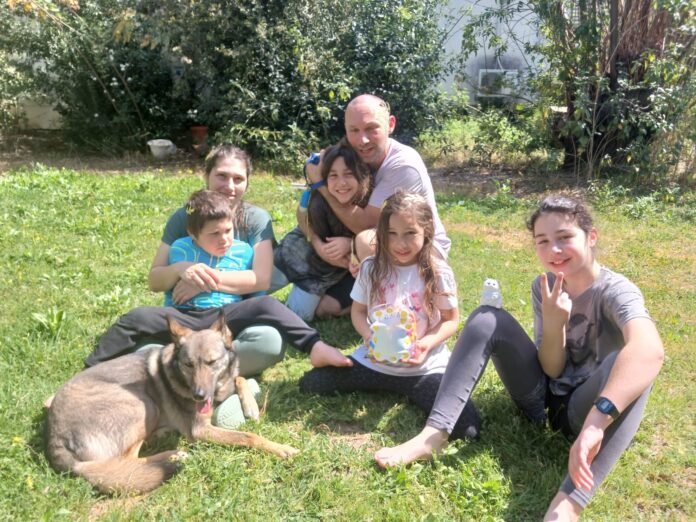
Rocket attacks have followed Anat Dymshits for most of her life.
After immigrating to Israel from the former Soviet Union as a child, she grew up in the northern border town of Kiryat Shmona, which suffered Katyusha rocket attacks from Lebanon-based terrorists for years.
After completing her military service, Dymshits, 36, pivoted to the Negev in southern Israel to study, moving with her husband, Michael, 38, to Kibbutz Holit in 2014, just after Israel’s Operation Protective Edge against the Hamas terror group.
During the massacres on October 7, 2023, Hamas terrorists invaded Holit, a tiny, remote community close to the Gaza and Egyptian borders, and slaughtered 15 of its 150 members.
Gunmen entered the Dymshits home and, unable to open the handle of its protected space, shot at the door, seriously wounding her parents, Alla, then 57, and Iosef Rojansky, then 67, who were visiting, and her daughter Ofek, then six. Dymshits and another two of her children, Lavi, then four, and Gefen, then eight, were injured by shrapnel.
The Dymshits family is one of many that left the Gaza border for central Israel after October 7 and who now find themselves in the middle of the Iranian storm, as missile fire sends Israelis running to bomb shelters multiple times daily amid the ongoing US-Israeli aerial campaign against Iran’s clerical regime.
For the past two years, all nine family members — including her grandmother, Yulia Fainshtein, now 88 — have been living on Kibbutz Be’erot Yitzhak, near Yehud in central Israel. Initially, the move was made to be close to the hospitals where the three most severely hurt members of the family were being treated.
Doctors amputated Iosef Rojansky’s left leg from the knee down and performed multiple surgeries on Alla, who was only released 11 months later. Both still have mobility problems. Ofek also had surgery and came home after a fortnight. While physically recovered, she has post-traumatic stress disorder and is prone to sudden anger outbursts, according to her mother. She is receiving emotional therapy along with two of her siblings.
With her husband away at work during the day, Anat has all four children at home, including the eldest, Shani, 12. Ofek has been diagnosed with ADHD, and Lavi, now 6, is on the autism spectrum. Lessons are being held on Zoom, which Dymshits said is a challenge in itself. Every rocket alarm means running to a neighborhood shelter or to someone else’s home, which makes it nearly impossible for the children to focus, she said.
Nights are being spent in the neighborhood shelter, she added.
“Things are unstable all the time,” she went on. “We will go back to Holit, to a different house, but we don’t yet know when.”

“Rocket attacks have always been part of the children’s lives. At home, we could go into the protected room. Here we always have to look for a place to run to. The army says a terror invasion won’t happen again, and I want to believe that. I love the area [around Holit], and have friends there. The kids are still in touch with their friends. We’ll go there and see how it is,” she said.
From Be’eri to Tel Aviv
The instability, the yearning of the children to see their friends, and the security-related fears of returning to the Gaza border are totally familiar to the Stern family from Kibbutz Be’eri.
Eviatar and Gal Stern and their three young boys, now aged 9, 7, and 2, survived one of the worst onslaughts on any kibbutz on October 7.
Roughly one in 10 residents were murdered in both Holit and Be’eri, but the latter is far larger.
Gal Stern’s mother, Tami Suchman, was murdered, and her Be’eri home was set on fire that day.
After more than 20 hours in their protected room, together with a neighbor and the family dog, the Sterns were rescued by “Elhanan’s team.” On hearing about the Hamas assault, brothers Elhanan and Menahem Kalmanson, later joined by a nephew, Itiel, drove south from Otniel in the West Bank and battled Hamas terrorists in Be’eri for hours, helping to evacuate dozens of survivors. Elhanan was shot dead on October 8 by a group of terrorists that had managed to hide in a kibbutz house.
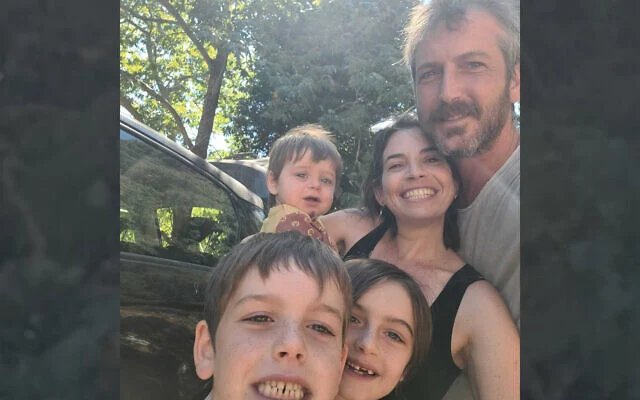
The Sterns initially spent four days with Gal’s sister in central Israel, joined by two of Gal’s brothers, one a member of Be’eri, the other of Moshav Netiv Ha’asara.
But after a subsequent two months with the rest of the Be’eri community in a Dead Sea hotel, the family was feeling “suffocated,” according to Eviatar Stern, and decided to move temporarily to Tel Aviv to undergo rehabilitation as a family there.
Stern had been a farmer before October 7, but answered a call to manage Ayuna, a bespoke carpentry workshop in Kibbutz Be’eri whose owner and driving spirit, Yonat Or, was murdered on October 7.
Stern drives to Be’eri and back on most days — it can take 90 minutes to two hours in afternoon traffic — while Gal is employed as a Maccabi health fund social worker in Tel Aviv.
The Sterns, all of whom are in therapy, are renting a house. They share a bomb shelter with the next-door neighbor. The night before Eviatar Stern spoke with The Times of Israel, there had been four rocket alerts.
“The alerts trigger the kids,” he said. “Every siren makes them jump. It’s hard for them to fall asleep at night. We talk about things as much as possible, about fears, nightmares, and terrorists. We’re all more anxious, edgy. There’s no school, no normal.”
“Gal is working from home,” he said. “I try to be there a bit in the mornings. We go to the playground where there are protected spaces to meet friends. But we’re all tired. It’s exhausting.”
One of Gal’s brothers has already returned to Moshav Netiv Ha’asara. The other is with the Be’eri community, living in temporary housing at Kibbutz Hatzerim, in southern Israel, while Be’eri is being repaired and rebuilt.
“We don’t know what the security situation will be,” said Stern. “We want to return, but we really don’t know whether we will.”
Fuente:
www.timesofisrael.com


