

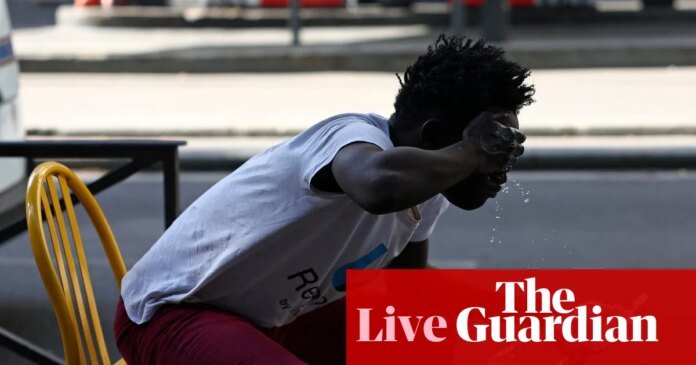
94 million Europeans to experience temperatures above 35C today, AFP estimates show
Jakub Krupa
To quantify it for you, at least 94 million people in Europe are expected to experience temperatures above 35C today, most of them in France and Spain, according to AFP estimates.
More than 350 million people will experience temperatures above 30C.
That’s two-third of the continent’s population – and we are only in June!
Share
Key events
22m ago
If you child’s school is open, keep sending kids in, UK education secretary says
33m ago
How is the extreme heatwave affecting you? Let us know.
47m ago
Heatwave hits Europe with temperatures well above 30C – in pictures
1h ago
Remember to stay hydrated
1h ago
Next UK PM needs to ‘stay the court’ on climate policies to reduce fossil fuels dependence, campaigners say
2h ago
French city of Nantes reporting temperatures above 40C
2h ago
Look after your pets, change their routines to protect them in heat, charities say
2h ago
94 million Europeans to experience temperatures above 35C today, AFP estimates show
2h ago
‘I don’t get paid if I don’t work’
2h ago
‘I know what the weather should be like in Paris, and it is not this’
3h ago
‘It’s dangerous’: how UK schools, care homes and other workplaces are coping in soaring heat
3h ago
Red alert for 16 cities in Italy as extreme temperatures expected today
4h ago
‘The heat was at a different level’
4h ago
Lib Dems urge government to open ‘cool hubs’ to help vulnerable people at UK braces for extreme heat
4h ago
Europe heatwave ‘putting people’s health at risk,’ WHO chief warns
4h ago
Europe battles record-breaking heat: is this the new normal? – The Latest
5h ago
Heat-related incident leaves 68,000 households with no electricity in northern France
5h ago
Rare red heat warning kicks in the UK with temperatures expected to get near 40C
7h ago
UK June record to get ‘absolutely smashed’, BBC forecaster predicts
7h ago
UK train delays and disruptions
8h ago
Power outages in France
8h ago
Opening summary
If you child’s school is open, keep sending kids in, UK education secretary says

Sally Weale
Education correspondent
Hundreds of schools in England have closed or are closing early due to the heat this week, but the education secretary has urged parents to continue sending their children to school if it is open.
As the UK continued to swelter in heatwave conditions, Bridget Phillipson reminded parents about the cost of missed lessons and school absence, which the government has been grappling with since Covid.
She said: “I know hot weather can be a struggle. But my message to families is simple: if your child’s school is open, you should keep sending them into school.”
“Teachers are relaxing uniform rules, keeping classrooms cool, making sure children are hydrated, teaching critical skills like water safety, and avoiding vigorous activity on the hottest days.
If your child has medical needs which mean you’re especially worried about the heat, talk to your school about what they can do.
Every day of absence and lesson missed has a cost – and that cost falls hardest on our most disadvantaged pupils and working class communities. So, pack a water bottle, put on the sunscreen, and trust that your child’s school has got this.”
Share
How is the extreme heatwave affecting you? Let us know.
As we go into later afternoon on the continent, Nantes and Bordeaux are now both in the 40s. Paris is reporting 39C, as is Toulouse.
It’s 34C in London.
This is not normal.
Let us know how you are coping with the extreme weather and how is it affecting you.
Share
Heatwave hits Europe with temperatures well above 30C – in pictures
Share
Remember to stay hydrated
In these extreme temperatures, please do remember to stay hydrated.
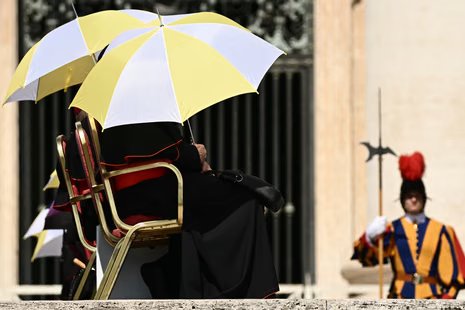
Here is Pope Leo leading by example and drinking a glass of water at the end of his weekly general audience.
Share
Next UK PM needs to ‘stay the court’ on climate policies to reduce fossil fuels dependence, campaigners say
Over in the UK, as the country faces breaking temperature records for June that have stood for 50 years since the summer of 1976, campaigners have called for the next Prime Minister to “stay the course” on climate policies, PA reported.
Greenpeace UK’s political campaigner Angharad Hopkinson said:
“The summer of ’76 may be seared into the nation’s memory, but it’s quickly being overtaken by even more terrifying heatwaves.
The only way off this hellish treadmill is to reduce our dependence on fossil fuels.
Our next prime minister needs to act on the evidence outside their window and the advice of their scientific advisors and stay the course on climate policies.”
Share
A heatwave sweeping western Europe reduced France’s nuclear output on Wednesday as high temperatures across the country reduced access to water needed to cool reactors, Reuters reported.
Output was reduced by 4.1 gigawatts, or 7%, of total power demand at midday, data from French utility EDF showed.
Share
French city of Nantes reporting temperatures above 40C
The French city of Nantes is currently one of the – if not the – hottest places in Europe, reporting 41C.
It’s 39.3C in Bordeaux and Bilbao across the border in Spain, 37C in Toulouse, and 37C in Paris.
German city of Stuttgart is reporting above 33C, as is the British capital, London.
Share
Look after your pets, change their routines to protect them in heat, charities say
Special words of warning to all pet owners, so that you look after your dogs and cats and whatever other animals you have in these extreme temperatures.
The animal welfare charity RSPCA has called for “an immediate routine change for dog owners during the next 48 hours” to protect their furry friends.
Lauren Bennet, dog welfare expert at the RSPCA and a former veterinary nurse,said:
“During a red weather warning, dog owners should think of it like a temporary lockdown for their pets. For the next 24- 48 hours, routines need to immediately change.
This isn’t the time for walks, chasing the ball or playing fetch, or exposing pooches to energetic exercise.
It’s far better for dogs to miss a few walks completely than to suffer the potentially fatal consequences of overheating, or heatstroke. …
Fresh water, air flow, shade and mental enrichment can make all the difference during this intense period of extreme heat.”
There is also some useful guidance from the Dogs Trust in the UK.
Share
94 million Europeans to experience temperatures above 35C today, AFP estimates show

Jakub Krupa
To quantify it for you, at least 94 million people in Europe are expected to experience temperatures above 35C today, most of them in France and Spain, according to AFP estimates.
More than 350 million people will experience temperatures above 30C.
That’s two-third of the continent’s population – and we are only in June!
Share
It’s time to update our weather forecast for today.
As you can see, large parts of western and central Europe are going to see high 30s and low 40s today.
And if anyone further east, say in Berlin, Prague or Warsaw is tempted to think: oh, that’s not affecting me then – you just wait for the weekend, when central and eastern Europe is about to be hit with the same heatwave as it moves eastwards.
Berlin is set to top 40C on Sunday, while Warsaw and Prague are both expected to see temperatures hit 39C.
Share
‘I don’t get paid if I don’t work’

Nicola Slawson
Maria*, 43, a self-employed sewing teacher originally from Spain who now lives in Amsterdam, has decided not to teach a six-hour class in Utrecht in the Netherlands on Friday because of concerns about the extreme heat.
She teaches in a former shop unit with large windows, no blinds and no air conditioning. Temperatures are forecast to reach 40C in Utrecht.
“It was really hard for me because I’m a people pleaser. I felt bad saying, ‘I’m sorry, but this is too much for my body.’ But I stuck with that feeling and I’m proud of myself for that.”
As a freelancer, cancelling work means losing income.
“I was going to work for six hours and if I don’t work, I don’t get paid,” she says. “If you’re self-employed and you don’t take care of your health, nobody else will.”
Maria believes many people in northern Europe are still underestimating how much the climate is changing.
“When you talk to people, they say, ‘Oh, but it’s only a few days.’ But it isn’t really only a few days any more. It’s getting hotter and hotter.”
Having lived in London for 11 years before moving to the Netherlands, she says she has watched summers become noticeably hotter.
“My first summer in London felt like there was no summer at all,” she says. “Then, year by year, it got hotter. Now London has summers that feel much more like Spain, and places like the Netherlands are getting temperatures that used to be associated with southern Europe.”
She worries that buildings, workplaces and public transport systems are not adapting quickly enough.
“I think people are closing their eyes to what is happening,” she says.
“It’s obvious that climate change is here. Hopefully more measures will be put in place in the future.”
*Name has been changed
Share
‘I know what the weather should be like in Paris, and it is not this’
Jane Clinton
Clara, 31, a librarian from Paris, France, says she would like to see a law passed to ensure workers can stop working when temperatures get too high.
At present, there are no maximum temperature thresholds in France.
“I work in an old, unrenovated building, which is south-facing, with poor insulation,” she says. “There’s no air conditioning, and as it is a public building, we of course cannot leave the windows open at night to help cool it down.”
She says they have small plastic fans, but once she steps away from them, the heat hits her, making it difficult to work. Getting to and from work is also uncomfortable.
Clara says train services have been reduced “because the heat is damaging the rails and carriages”. She describes her commute to work as “boiling” and says she has felt unwell while travelling.
Clara, who lives in a south-facing “old apartment” with poor insulation, says the temperature in her home has reached 30C.
“I know it is likely to get higher until the end of the heatwave, which causes me great anxiety as I struggle to ventilate it and can’t sleep at night because it’s too warm. I don’t have A/C, just a fan, but that overheats as I have it on so much.”
Clara, who was born in Paris, says she is very worried about the wider picture concerning the extreme heat.
“I know what the weather should be like in Paris, and it is not this,” she says.
“We are hearing everywhere that this is an unprecedented event and likely to get worse, but my government is doing nothing. The only advice we’ve received is to drink more water. There are few other official guidelines, and no set temperature at which work is cancelled. Everything is offloaded on individuals; it’s on us to do the right thing and protect ourselves while the country burns around us.”
Share
‘It’s dangerous’: how UK schools, care homes and other workplaces are coping in soaring heat
Patrick Butler, Richard Adams, Andrew Gregory, Amelia Hill, Steven Morris, Gwyn Topham and Matthew Weaver
With temperatures in the UK approaching record levels for June, people are being advised to avoid exercise and unnecessary travel.
So how do you even work in this heat?
We look at how various sectors of the economy are coping with unprecedented temperatures, and how working practices will have to adapt to increasingly frequent heatwaves that are predicted to be longer and more intense owing to the global climate emergency.
For example, school leaders say it is lucky the heatwave arrived after the summer GCSE and A-level exam season, just as May’s heatwave coincided with most schools being closed for half-term.
“We’re dodging a few bullets, but I’m not sure how much longer we can keep dodging,” said Jo Rowley, a deputy headteacher in Stafford..
Share
Red alert for 16 cities in Italy as extreme temperatures expected today
Italy’s health ministry issued “red alerts” for 16 cities on Wednesday with major cities such as Rome, Milan, Florence and Turin affected, AP reported.
The “bollino rosso” red alert signals emergency conditions that can affect not only vulnerable people but also healthy adults.
Temperatures could reach highs of 41C in Florence and 38C in Milan, while Rome and Naples are forecast to remain below 36C.
Share
It’s not even midday in continental Europe, and some parts of France are already reporting temperatures above 36C (Bordeaux) and even near 38C (Nantes).
Paris is reporting 35C.
Share
‘The heat was at a different level’
Jane Clinton
Alex*, 37, who works in EU institutions in Brussels and is from Spain, says that while he is used to high temperatures, he has seen how other countries are struggling with insufficient infrastructure to cope with extreme heat.
He says temperatures of “38C, 39C, even 40C are not unheard of in Southern Spain in July and August”.
“I have lived in Northern Europe, and these regions are definitely not used to these temperatures,” he says.
“I think it is a big shock for the local population, and for the infrastructure too. It’s just not adapted to this heat. Air conditioning in restaurants and shops is not as common as it is in Spain, so 40C in Spain to me feels relatively manageable, also, because I think the climate is drier, whereas 40C, 42C, as we had in France, is very difficult.”
Alex was on holiday in Madrid over the weekend and drove back to Brussels with his A/C “on full power”.
“I drove through western France, and all the road informational screens recommended rest and hydration,” he says. “This level of heat is something that I think, particularly in central and southern Spain, we are more or less used to, at least in my lifetime.”
He says he did the same journey “a few years ago” in July and was able to stop off and climb the Grande Dune du Pilat in the Arcachon Bay area, south west France. This time, however, the heat was so intense that they had to wait several hours before they could make the climb.
“I remember going up there in July, and it was beautiful,” he says.
“This year I had to wait until sunset until 9.30pm because of the heat – it wasn’t safe to go there at 5pm, which was my original intention. Compared to other trips, the heat was at a different level this year.”
*Name has been changed
Share
Updated at 11.42 CEST
Jakub Krupa
The Guardian’s Jane Clinton has been speaking to some people affected by the heatwave.
Let’s check what they’re saying.
Share
Source:
www.theguardian.com


