
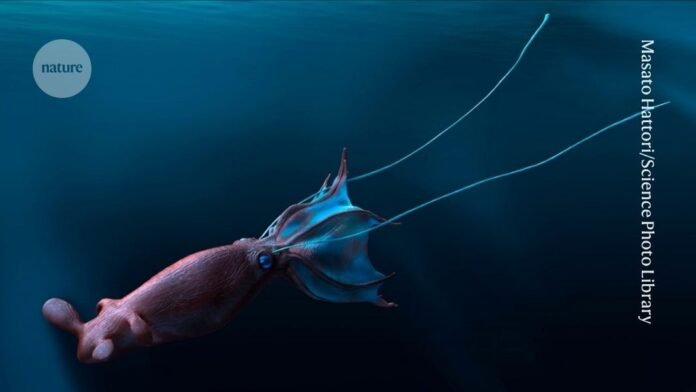
Artist’s impression of an extinct Nanaimoteuthis species, often called krakens, which could have rivalled large marine reptiles in terms of size.Credit: Masato Hattori/Science Photo Library
In the age of the dinosaurs, while Tyrannosaurus rex terrorized the land, gargantuan octopuses might have been among the top predators in the sea.
Scientists have identified extinct octopuses — sometimes named krakens after the mythological monsters — that might have grown to nearly 19 metres in length. The estimate is based on fossilized jaws, which the researchers say show patterns of wear that came from devouring animals that had hard shells and skeletons.
Their study, published on 23 April in Science1, challenges the idea that giant marine reptiles such as mosasaurs and other vertebrates exclusively dominated marine ecosystems in the Cretaceous period 143 million to 66 million years ago. But other scientists say the largest size estimates of the octopuses — around the length of an articulated lorry — and any firm conclusion about their role in ecosystems should be taken with a pinch of salt.
Deep-sea denizens
‘Krakens’ have been identified from chitinous jaw fossils from the late Cretaceous . But their size range, diet and role in ecosystems were unclear, says study co-author Yasuhiro Iba, a palaeontologist at Hokkaido University in Japan.
To plug such gaps, Iba, together with Hokkaido palaeontologist Shin Ikegami and their colleagues, reanalysed 15 large fossil octopus jaws. They also identified 12 new kraken fossils through an analysis of carbonate rock layers assisted by artificial intelligence, an approach Iba’s team used to discover an explosion in squid diversity 100 million years ago2.
The analysis grouped the krakens into two species: Nanaimoteuthis jeletzkyi and N. haggarti, and discovered that they belong to the same evolutionary group as modern dumbo octopuses (Grimpoteuthis species).
On the basis of the anatomy of modern octopuses, the researchers estimate that the krakens’ mantles — the main, bag-like parts of their bodies — would have been between 67 and 443 centimetres long. Including the tentacles, N. jeletzkyi could have grown to between 2.8 and 7.7 metres in length, and N. haggarti from 6.6 metres to a whopping 18.6 metres.
“Some people will doubt that it really grew to 19 metres. I’m pretty sure about that,” says Christian Klug, a palaeobiologist at the University of Zurich in Switzerland, who was not involved in the research. The relationship between the mantle and tentacles of modern cephalopods is highly variable, so the lower or middle bounds of the size estimates could be more likely.
Source:
www.nature.com


