

The chair of the Knesset Foreign Affairs and Defense Committee, MK Boaz Bismuth, said on Monday that he would resume advancing a controversial bill that would enshrine sweeping exemptions from military conscription for Haredi yeshiva students, after briefly stopping work on it at the start of the war with Iran.
Bismuth, a member of Prime Minister Benjamin Netanyahu’s ruling Likud party, said the bill would be put back on the agenda as part of a broader legislative package intended to shore up the Israel Defense Forces, which is being strained by fighting on multiple fronts.
Along with the Haredi conscription bill, the package will include bills that lengthen the term of mandatory military service and further regulate reserve duty.
Bismuth confirmed in an address in the Knesset on Monday evening that he would be moving to advance the legislation only after the conclusion of the war with Iran.
He said the decision to press ahead with the controversial legislation was made at the request of IDF Chief of Staff Lt. Gen. Eyal Zamir.
Zamir reportedly warned a cabinet meeting last week that the military would soon “collapse in on itself” if the manpower shortage wasn’t resolved.
“Right now, the IDF needs a conscription law, a reserve duty law, and a law to extend mandatory service,” he was quoted as saying.
Bismuth, alluding to this warning, said the government would “continue doing exactly what the chief of staff wants, and that is to advance the conscription law because our soldiers are important to us.”
But IDF officials have previously warned that the legislation currently on the table would fall short of solving the manpower shortage and even make it worse.
Bismuth’s touted conscription bill is the result of a decades-long battle over the practice of issuing blanket exemptions from military service to ultra-Orthodox men. In June 2024, the High Court ruled that there was no legal basis for the practice and ordered the government to draw up a law to begin drafting military-age men from ultra-Orthodox communities.
Critics have warned, however, that the current version of the bill — drafted after the previous committee chairman was booted by Likud for attempting to penalize draft dodgers — would do the opposite of its intended goal, and instead enshrine continued exemptions for full-time Haredi yeshiva students.
It has come under fire from IDF brass, the attorney general, and a wide array of other critics, who have objected to it on the grounds that it is full of loopholes and preserves inequality in the mandatory draft.
They have warned that ultimately, the bill will not increase Haredi enlistment amid what the military says is a manpower shortage after over two years of fighting on multiple fronts.
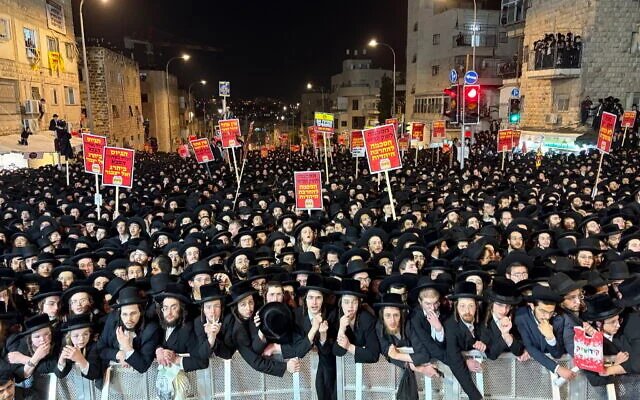
The legislation had initially been intended to pass as part of the 2026 state budget, but was removed following the outbreak of war with Iran on February 28, to ensure that the budget could pass as fast as possible to help cover the cost of the fighting.
Although the Knesset’s Haredi factions had initially threatened to withhold support from the budget unless their conscription bill was passed at the same time, they ultimately agreed to support it sans the legislation, given the circumstances.
Ahead of the vote, however, Hebrew media reported that the ultra-Orthodox Shas and United Torah Judaism parties had conditioned their support for the budget on the draft exemption bill being reintroduced following its approval.
Lawmakers voted 62-55 in favor of the budget in the early hours of Monday, avoiding early elections, which would have been triggered if the budget failed to pass before March 31.
Opposition lawmakers widely panning Bismuth on Monday were joined by a rare dissenting voice from within the coalition, as Deputy Foreign Minister Sharren Haskel cautioned that the bill would endanger national security during wartime and accused the Haredim of trying to buy time until the next government is voted in, at which point, she said, they would demand blanket exemptions.
“Anyone who endangers the security of the State of Israel at a time of war, and exempts those eligible for conscription when the chief of staff waves a red flag and begs for combat forces, will not be forgiven by the public,” she warned.
Haskel, a member of Foreign Minister Gideon Sa’ar’s New Hope party, has previously said she knows of at least six other coalition legislators who planned on opposing Bismuth’s bill when it is put to a vote.

Source:
www.timesofisrael.com


