
KUALA LUMPUR, Malaysia — Australia’s revised National Defence Strategy, released last week, promises increased defense spending and greater self-reliance, but no dramatic change in approach commensurate with a changing security situation, according to analysts.
Malcolm Davis, senior analyst at the Australian Strategic Policy Institute (ASPI), told Defense News the NDS has many positives, as does the Integrated Investment Program (IIP) released simultaneously, but the foundational documents lack urgency.
Given the China threat looming over Taiwan, for example, “I don’t think we have a ten-year warning period anymore. That’s clearly gone, and I suspect we maybe have one or two years to really get ready.”
Nonetheless, Davis believes the strategy is “broadly heading in the right direction.” He said the strategy “strengthens our ability to project power and presence, which is great, and also strengthens resilience, including defense industrial capacity.”
New equipment
The IIP allocated A$425 billion (US$307 billion) from 2026-2036 to accelerate capability improvements. Some 41% of these funds go on maritime capabilities, 22% on enterprise and enabling (e.g. infrastructure and information technology), 17% on land, 14% on air, 5% on cyber and 2% on space.
However, Davis asked: “I suppose the big takeaway with the IIP, how quickly can it deliver capability?”
He continued: “All the things are positive, but I think what we’ll need to do is move faster and acquire capability more quickly, build up resilience and sustainability more rapidly.”
Little changes materially for the Australian Army. The service receives money for littoral maneuver – particularly medium and heavy landing craft – so it can better move new assets like Redback infantry fighting vehicles, M1A2 Abrams tanks, AS9 self-propelled howitzers and Boxer 8×8 vehicles around north of Australia.
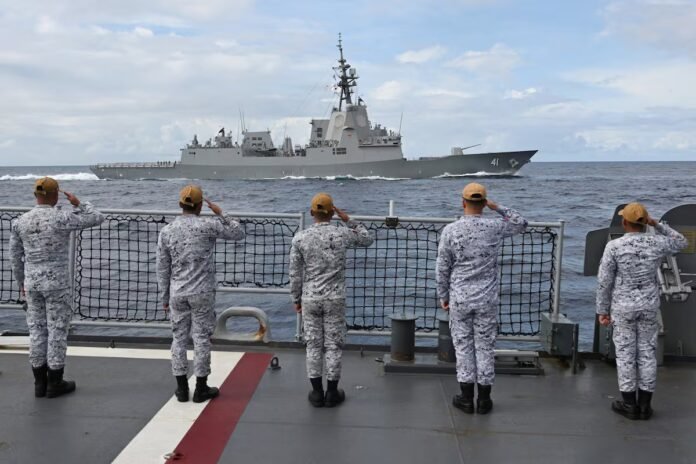
The Royal Australian Navy is the biggest recipient of funds, as the service receives eleven new Mogami-class frigates from Japan and six Hunter-class frigates. It reaffirms interest in six large optionally crewed surface vessels armed with up to 32 missile cells.
The tiger’s share – up to A$96 billion – goes on nuclear-powered attack submarines, representing Australia’s largest ever defense allocation.
Responding to naysayers questioning the AUKUS submarine program, Minister for Defence Industry Pat Conroy said, “I’ve got complete confidence in the Australian industry’s ability to do the work. I was in the U.K. in February, and I saw the first parts of the reactor modules for our first two submarines being built right before my eyes. So this project is on track.”
Turning to the Royal Australian Air Force, incoming is a fleet of 20 C-130J-30 Hercules transport aircraft, but the RAAF is going to get rid of its C-27J Spartans because of their cost to sustain.
F-35A fighters will receive new long-range missiles like the LRASM and JSM, plus Super Hornets and Growlers will undergo upgrades to keep them operational until 2040. Up to A$8.1 billion will go on unmanned aircraft like the MQ-28A Ghost Bat.
Significantly, the government is committing A$21 billion to A$30 billion over the decade to “deliver a layered, integrated air and missile defense capability to detect, track, counter, withstand and recover from missile attacks.”
Belatedly learning lessons from modern conflicts, the IIP stated a medium-range air defense “program will commence as a priority from 2026.” Western stocks of interceptors are drained because of current conflicts, so this could represent opportunities for suppliers like South Korea offering local production.
Funding
The NDS laid out how funding would swell to 3% of gross domestic product (GDP) by 2033/2034. Conroy trumpeted that current defense spending of 2.8% of GDP “puts us ahead of all like-minded countries in the Indo-Pacific. It puts us ahead of almost every NATO country except for the United States, and countries on the frontline against Russia, like Poland.”
In the latest promises, Canberra promised an additional A$14 billion in spending over the next four years, and an extra A$53 billion over the decade, compared to previous estimates.
According to these figures, this breaks down to just A$3.5 billion extra annually for the next four years, and an average of A$6.5 billion yearly after that.
Nonetheless, cumulative defense expenditure over the coming decade is projected to reach A$887 billion, including A$112.1 billion for 2035-2036 alone. The government highlighted a 7.6% annual average growth rate in the defense budget over the coming decade.
Davis was pleased about the government’s willingness to increase the defense budget, but questioned whether it is sufficient and soon enough. “I suspect, given the rapid deterioration and the strategic outlook, they’ll probably need to boost that even further than what they’re planning.”
He noted, given events like the Iran war, that “the strategic environment is deteriorating faster than their financial planning cycles are assuming.”
Mick Ryan, Senior Fellow for Military Studies in the Lowy Institute, concurred. He wrote, “The spending increases contained in the National Defence Strategy and its accompanying Integrated Investment Program are relatively modest compared to the scale of the security challenges now faced by Australia.”
US relations
Discussing greater self-reliance, Defence Minister Richard Marles remarked at the document launch: “We’ll work with all our likeminded partners to better shape our region’s strategic trajectory. We’ll double down on middle-power cooperation. But let’s also be clear: There’s no effective balance of power in the Indo-Pacific absent the continued presence of the United States.”
Richard Gray, a resident senior fellow at ASPI, also wrote, “We couldn’t easily replace the U.S. even if we wanted to, and in practical terms it remains an indispensable security partner. It has capabilities that Australia can’t or won’t replace.”
Davis highlighted that self-reliance is interlinked with the U.S. relationship. “By investing in greater self-reliance capability, we can burden share with the U.S. to a greater degree, and thus ensure the U.S. remains engaged in the region,” he said. “I think that’s crucial.”
Gordon Arthur is an Asia correspondent for Defense News. After a 20-year stint working in Hong Kong, he now resides in New Zealand. He has attended military exercises and defense exhibitions in about 20 countries around the Asia-Pacific region.
Source:
www.defensenews.com


