

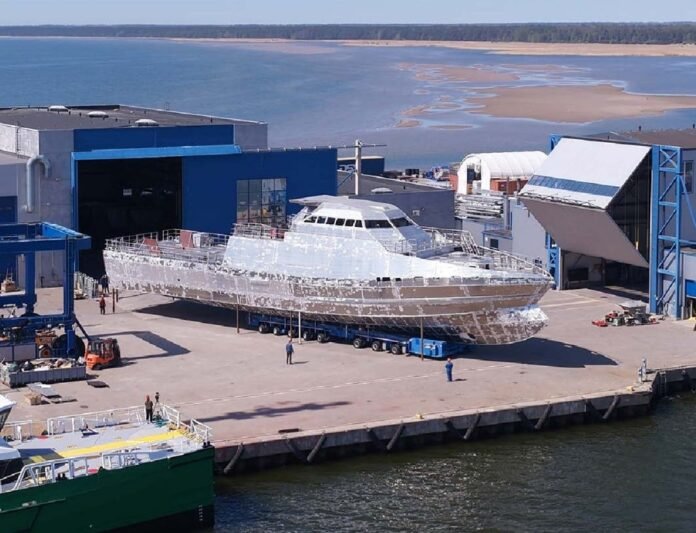
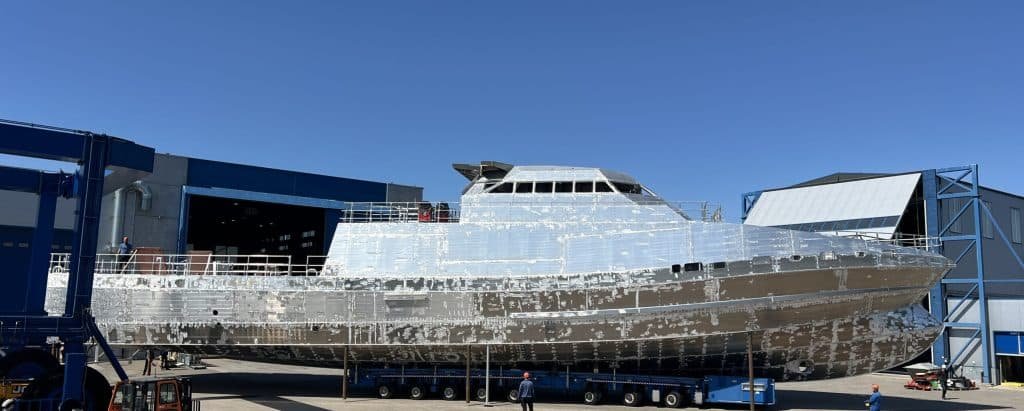
The European Defence Fund’s (EDF) €95 million EUROGUARD program has completed its Critical Design Review (CDR) and unveiled its 45-meter semi-autonomous prototype hull at the Baltic Workboats shipyard in Estonia.
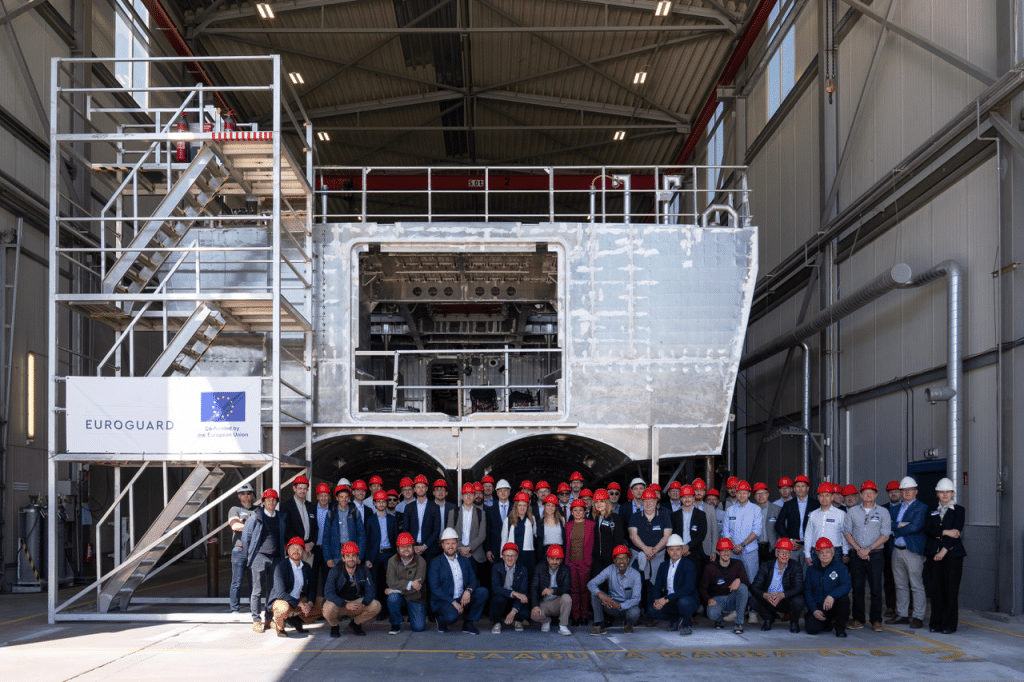
On May 21, 2026, EUROGUARD project marked a major milestone at the Baltic Workboats shipyard in Nasva, Estonia, hosting its Critical Design Review (CDR) alongside the prototype vessel hull presentation and a virtual system demonstration. Event brought together consortium partners and representatives of participating Member States, highlighting progress in one of the largest projects funded under the EDF.
“The Critical Design Review confirms that the EUROGUARD system is moving from design to operational reality,” said Project Coordinator Martin Laur. “It reflects strong European cooperation in delivering next-generation maritime defence capabilities.”
The review will validate the design of the EUROGUARD demonstrator, integrating advanced technologies into a modular, semi-autonomous maritime platform. Participants will also see the physical progress of the prototype vessel and experience a virtual demonstration of its operational capabilities.
EUROGUARD is developing a 45-meter semi-autonomous modular vessel designed for missions such as surveillance and recconoisance, mine countermeasures, drone operations, and search and rescue. The €95 million project is funded by the EDF (€65 million) and participating countries and industry (€30 million).
EUROGUARD: Next-Generation Maritime Security
EUROGUARD is a EDF project (related PESCO project: Medium Size Semi-Autonomous Surface Vehicle – M-SASV) developing a modular, semi-autonomous surface vessel equipped with advanced remote-control systems and sustainable propulsion. Running from 2023 to 2027, the initiative aims to strengthen Europe’s maritime security capabilities through innovative technologies for next-generation naval operations. The EDF supports collaborative defence research and development, fostering innovation while strengthening Europe’s defence technological and industrial base.
Launched at the end of 2023, EUROGUARD has progressed rapidly from concept and design to a tangible prototype. A major milestone was reached on 27 May 2025, when Baltic Workboats laid the vessel at its shipyard in Nasva, Estonia. Over the course of the project, the consortium has advanced the vessel’s design, integrated key technologies, and developed the demonstrator. The project is scheduled for completion by the end of 2027, with sea trials to be conducted in Estonian waters in cooperation with the Estonian Navy.
EUROGUARD addresses the growing need for faster, more flexible maritime response capabilities by enabling coordinated operations between EU naval vessels equipped with advanced platform and mission technologies. The demonstrator vessel will integrate cutting-edge European technologies and support multiple modular mission payloads, allowing it to perform a range of coastal operations in representative operational environments.
The EUROGUARD M-SASV Concept
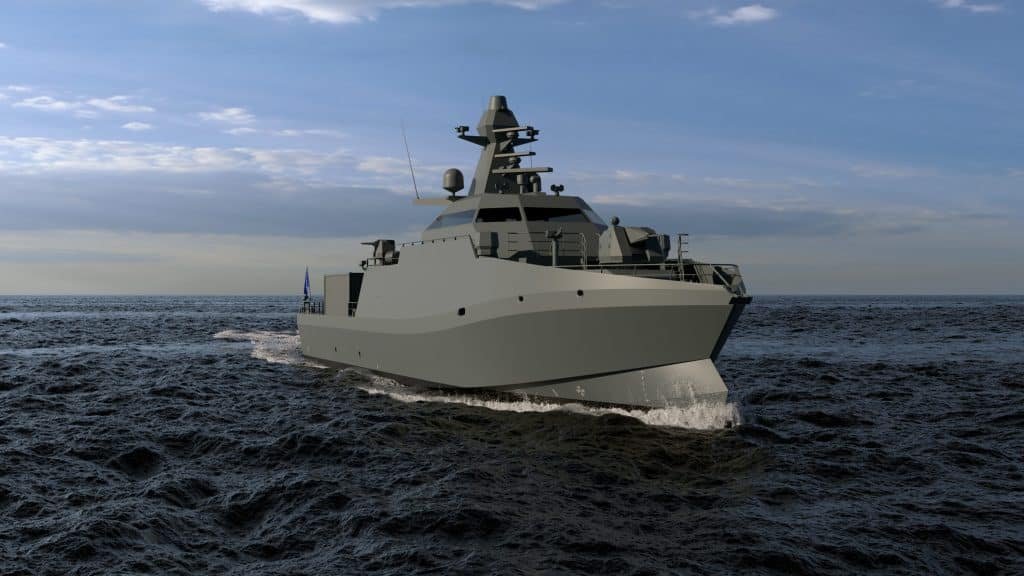
The vessel measures 45 metres in length, with a beam of 9.4 metres and a draft of 3 metres. It has a maximum speed of approximately 25 knots, amaximum range of 2,000nm and can accommodate up to 20 personnel, with a standard crew of 10 and a lean-manning configuration of six. The maximum displacement is about 335 tons. The vessel can carry a maximum payload of 100 tonnes, providing the flexibility to support a wide range of mission-specific equipment and modular payloads.
The onboard sensor suite includes a Leonardo SSR X400/6 surveillance radar, GEM Elettronica EOSS 450 electro-optical system, Marduk Shark drone detection system, an ELT Group electronic warfare suite, a Leonardo TMMR 3D radar, and a hull-mounted sonar, providing comprehensive situational awareness across the surface, air, and underwater domains. The communications include VHF, HF, UHF, STACOM, 5G and HiPAP 502 underwater communication from Kongsberg.
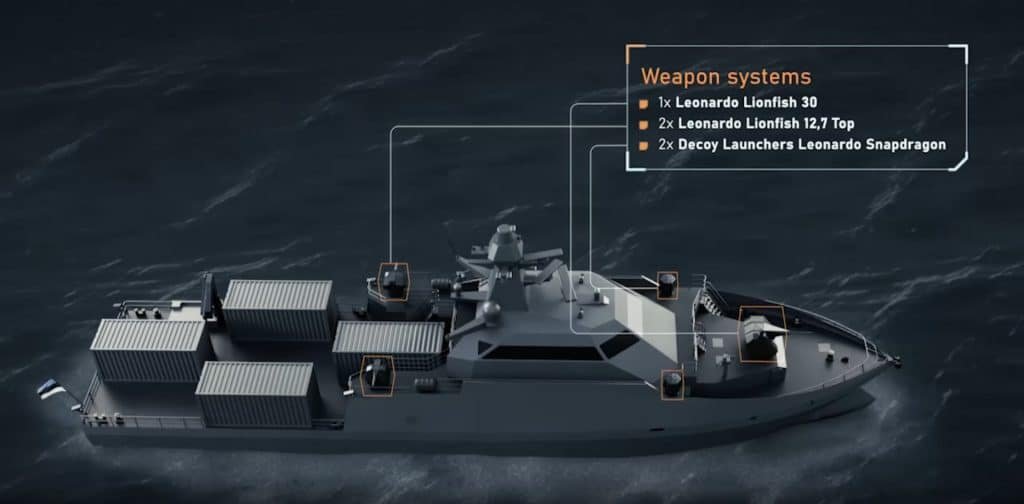
The standard armament consists of one Leonardo LIONFISH 30 30mm RWS, two Leonardo TOP 12.7mm RWS, and two SNAPDRAGON decoy launching systems, ensuring effective self-defence against a broad range of conventional and asymmetric threats.
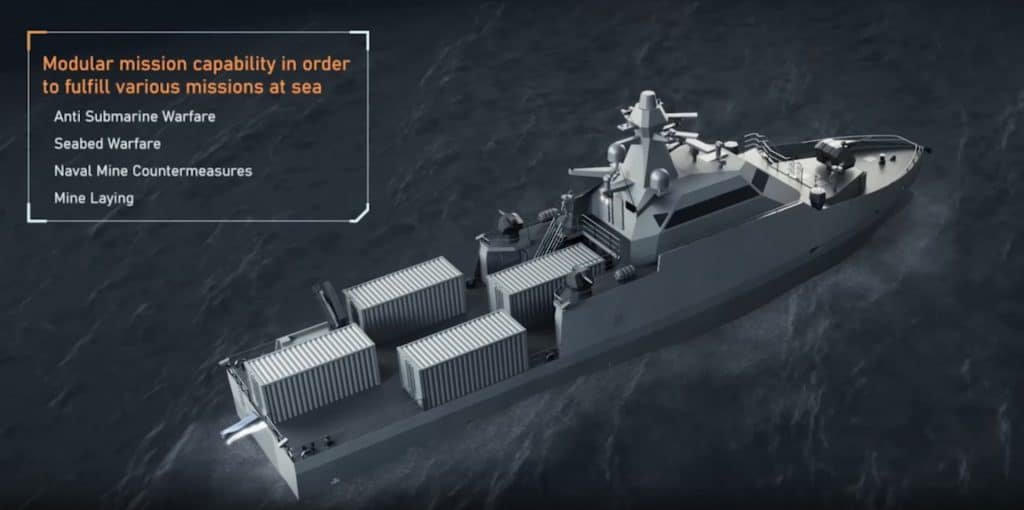
The vessel is being developed to accommodate interchangeable mission modules supporting a broad range of naval and maritime missions, including naval mine countermeasure (NMCM) operations, maritime surveillance and situational awareness (ISR), anti-surface warfare (ASuW), anti-submarine warfare (ASW), seabed monitoring and critical infrastructure protection (SBW), search and rescue (SAR), unmanned systems deployment and control, and environmental monitoring and maritime safety operations. The vessel’s modular architecture allows it to be quickly adapted to mission requirements, while its sustainable propulsion system contributes to Europe’s environmental objectives.
The prototype integrates advanced technologies to support semi-autonomous and remotely controlled operations. Core capabilities include human-machine teaming functionalities, autonomous navigation and route planning, obstacle and threat detection, collision avoidance systems, sensor fusion and situational awareness, secure communications and remote-control capabilities, and cyber-secure system architecture. A data-centric architecture and modern software framework will provide the flexibility, reliability, and resilience required for unmanned or lean-manned operations, enabling the vessel to operate either independently or as part of a coordinated fleet.
The EUROGUARD Consortium
The EUROGUARD consortium comprises the following organizations:
Baltic Workboats AS (Coordinator) – Estonia
Aircraft Development and Systems Engineering (ADSE) BV – The Netherlands
Akademia Marynarki Wojennej (eng. Polish Naval Academy) – Poland
Damen Schelde Naval Shipbuilding B.V. – The Netherlands
dotOcean N.V. – Belgium
ELETTRONICA SPA – Italy
Fincantieri – Italy
Kongsberg Maritime – Norway
Leonardo – Italy
Marduk Technologies – Estonia
Naval Group Belgium – Belgium
Naval Group SA – France
Navantia S.A., S.M.E. – Spain
Nederlandse Organisatie voor toegepastnatuurwetenschappelijk onderzoek (TNO) – The Netherlands
Odense Maritime Technology – Denmark
Osrodek Badawczo-Rozwojowy Centrum Techniki Morskiej SA – Poland
RHEA System B.V. – The Netherlands
Safran Electronics & Defense – France
SH Defence – Denmark
SSPA Sweden AB – Sweden
Stichting Maritiem Research Instituut Nederland – The Netherlands
Technische Universiteit Delft – The Netherlands
Thales DMS France SAS – France
Source:
www.navalnews.com


