
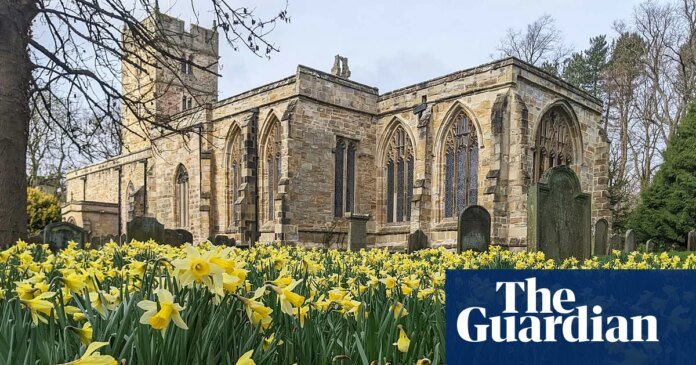
“Please close the door. It conserves heat and keeps the organ in tune,” requests the notice inside the church door. It’s pleasantly warm inside, on this chilly April morning. But on the night of 16 September 1998, temperatures here exceeded 1,000C, when fire consumed the old organ, along with the floors, window, roof and 900 years of history, leaving a charred shell.
Seven years of reconstruction and renewal followed, creating a light, airy interior: simple pale oak has replaced the darker, more intricate furnishings, and a new east window portrays an exotic floral paradise.
Helen Whittaker’s vibrant stained glass Paradise window celebrates the quest of the Irish traveller St Brandon, better known as St Brendan, who spent a lifetime searching for an earthly Garden of Eden. Early-morning sunlight, streaming through the glass, casts rainbow shadows of subtropical flowers that he might have encountered: strelitzia, jacaranda, hibiscus and angel’s trumpets. Below panes of red, orange, purple and blue, the artist has left clear glass panels, revealing the natural beauty of native trees in the churchyard beyond, itself a paradise for local wildlife.
February’s drifts of the snowdrops and winter aconites, around the grave of Jack Warner – a much-missed former colleague – gave way to daffodils in March. Today, bee-flies are darting between primrose flowers, in longer grass between mown paths. A buff-tailed queen bumblebee, searching for a nest site, explores a vole tunnel around an old tree stump. A seven-spot ladybird ambles across a lichen-encrusted table-tomb. The loudest sound comes from a song thrush. Otherwise, it is so quiet that I can hear the scratchy claws of a treecreeper climbing the bark of an ash tree.
Sympathetic churchyard management like this achieves a fine balance between respect for those whose life journeys ended here and the needs of nature, where another cycle of life is beginning.
One of the ancient churchyard yews is covered in tiny male, pollen-producing cones. On the way out, I give its branch a gentle shake and, for a second or two, a ghostly cloud of yellow pollen is suspended in a shaft of sunlight, then dissolves like smoke in the air as it rises through the branches.
Under the Changing Skies: The Best of the Guardian’s Country Diary, 2018-2024, is available now at guardianbookshop.com
Source:
www.theguardian.com


