
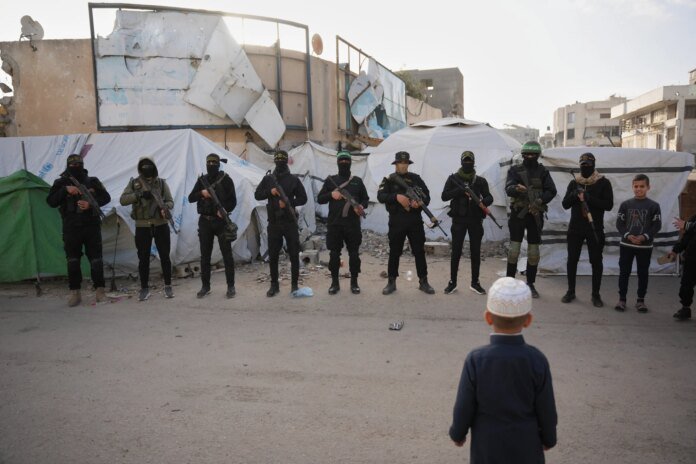
The Gaza Board of Peace has given Hamas until the end of the week to accept a disarmament proposal, with the US-led international body overseeing the postwar management of the Strip determined to advance its reconstruction even as the Iran war persists, three sources familiar with the matter told The Times of Israel on Monday.
The Board of Peace’s High Representative for Gaza Nickolay Mladenov met with a delegation of senior Hamas officials in Cairo on Friday, and the terror group has been informed that the Gaza oversight board wants a disarmament agreement finalized by the end of the week, two Arab diplomats and a third source said, confirming reporting in The New York Times on condition of anonymity.
The sources clarified that minor amendments to the disarmament proposal would still be considered, while requests for fundamental changes by Hamas would not be accepted.
Mladenov is convinced that it is possible to move ahead with the second phase of US President Donald Trump’s plan for ending the Gaza war, one of the Arab diplomats said, while acknowledging that Middle East mediating countries Egypt, Qatar and Turkey are not as optimistic.
The mediators are leaning hard on Hamas to accept the US-backed disarmament proposal, but the terror group is “unlikely to say ‘yes’ without significant caveats,” said the Arab diplomat, who is from one of the mediating countries.
“And even if they do, it’s unlikely that Israel will comply,” the diplomat added, arguing that Prime Minister Benjamin Netanyahu would not authorize an additional pullback from Gaza during an election year, as his coalition partners continue backing maintaining a permanent Israeli presence in the Strip.
At the Friday meeting in Cairo, Hamas officials refrained from outright rejecting the disarmament proposal, which Mladenov first presented to them last month, the Arab diplomat said.
Instead, they highlighted what they said has been Israel’s failure to adhere to the first phase of Trump’s plan, pointing to the limited operation of the Rafah Crossing, the low number of aid trucks that have gone into Gaza, the repeated IDF strikes deep inside Gaza and Jerusalem’s pushing of the Yellow Line ceasefire demarcator deeper into the Strip, thereby expanding the eastern portion of the territory controlled by Israel.
Israel took several months to reopen the Rafah Crossing after the October ceasefire. Even then, it has limited passengers to 50 in each direction and shut it back down for nearly the first three weeks of the Iran war. That latter conflict also has seen the daily aid truck count dip far below the 600 that are required under the ceasefire’s terms.
Israel has not denied carrying out strikes deep inside Gaza but says they are justified in targeting Hamas operatives violating the ceasefire.
Mladenov has raised some of these issues with Israeli officials in recent days, the Arab diplomat said, noting that the aid truck numbers have begun climbing back up, while other alleged violations have remained unresolved.
The Board of Peace’s Gaza envoy is slated to hold a follow-up meeting with Hamas officials in Cairo on Tuesday, the Arab diplomat and a source familiar with the matter said.
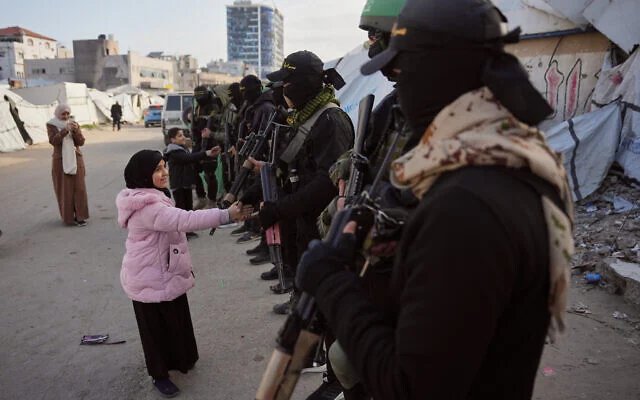
The Saturday deadline conveyed to Hamas in recent days came after the group dragged its feet in responding to the proposal it first received nearly four weeks ago.
That offer envisions the destruction of the group’s Gaza tunnel network along with the phased handover of its weapons.
The plan partially leaked to the media follows an eight-month timeline that begins with a Board of Peace-backed committee of Palestinian technocrats taking security control of Gaza and concludes with Israeli forces withdrawing completely upon “verification that Gaza is free of weaponry.”
Gaza’s entire reconstruction hinges on Hamas agreeing to disarm, with Mladenov indicating in a cryptic tweet last week that there would be consequences for the group if it didn’t get on board.
“He who will not cross the river will drown in the sea,” he wrote on X.
The leaked plan includes two components: a 12-point document titled “Steps to Complete the Implementation of Trump’s Comprehensive Peace Plan for Gaza,” and a five-stage timeline during which Hamas would surrender its arms over eight months.
The document says that all armed factions in Gaza, including terror groups like Palestinian Islamic Jihad, will participate in a disarmament process that will be overseen by the Palestinian technocrats, known as the National Committee for the Administration of Gaza (NCAG).
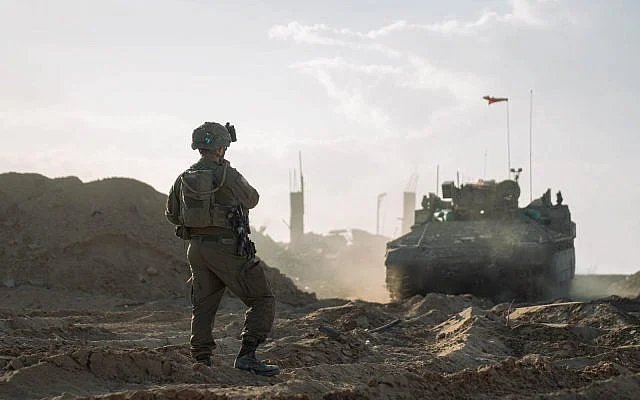
“Gaza will be governed under the principle of one authority, one law, one weapon, whereby only individuals authorized by [NCAG] may possess weapons, and all armed factions will cease military activities,” the document says.
The disarmament process will be “verified by the Weapons Collection Verification Committee,” a body that will be set up by Mladenov.
Reconstruction will only be allowed in areas that are designated as demilitarized, it says.
According to the plan’s timeline, the first stage, consisting of 15 days, would see NCAG take security and administrative control of Gaza and begin preparatory steps for weapons collection.
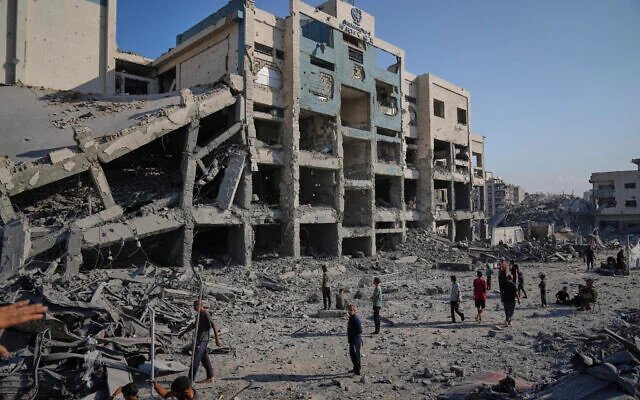
In the second stage, days 16-40, Israel would remove all heavy weapons from areas under its control, including heavy artillery and tanks, and an international security force would be deployed.
The third stage, days 30-90, would be the most intensive: Hamas would give all its heavy weapons and military equipment to NCAG, and “will allow the destruction of all tunnels, explosives and military infrastructure.”
In the fourth stage, days 91-250, NCAG’s police forces would collect and register all remaining weapons, including guns and rifles. Israeli forces would begin to withdraw in stages.
The fifth stage is described as “final verification” of disarmament, and would see “Israeli forces withdraw completely from Gaza except for a presence in a security perimeter, and the start of comprehensive reconstruction efforts.”
Reuters contributed to this report.

Source:
www.timesofisrael.com


