
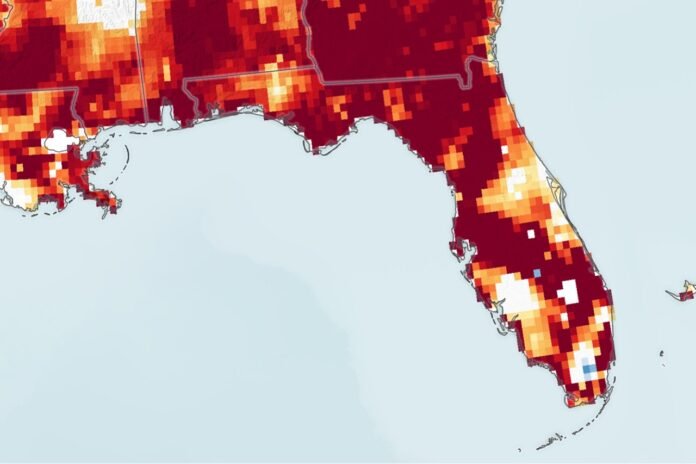
Florida is among the wettest U.S. states, but that doesn’t mean it is drought-free. Nearly all of Florida faced at least “moderate” drought, and nearly 80 percent faced “extreme” conditions in April 2026, according to data from the U.S. Drought Monitor. Unusually dry conditions gripped the state for much of 2025, but the intensity and extent of the drought ratcheted up starting in January 2026.
Data from a NASA and German Research Center for Geosciences satellite mission show that the drought has left its imprint on the state’s underground water supplies, which are often tapped for drinking water and farming. The map above combines data from the twin GRACE-FO (Gravity Recovery and Climate Experiment Follow-On) satellites and ground-based measurements to estimate the relative amount of groundwater stored underground as of March 30, 2026. The colors depict the wetness percentile, or how the amount of shallow groundwater compares to long-term records (1948–2010). Blue areas have more water than usual, and orange and red areas have less. Aquifers in the northern and central regions of the state are particularly dry.
The drought is being felt throughout Florida. Some water districts have imposed restrictions on when water can be used for certain activities, such as lawn watering and car washes. News reports suggest that the dry weather poses a threat to crops, many of which already suffered severe damage during hard freezes in February. Large wildland fires have flared up in some areas, and even wetland ecosystems like the Everglades face unusually dry conditions.
U.S. Drought Monitor records indicate that the current drought is the most widespread and severe to affect the state since 2012. Many areas have received less than half their normal rainfall since September 1, 2025, according to the National Weather Service. St. Petersburg has seen only 7.7 inches (195.6 millimeters) of rain since September 1, compared to the normal 19.0 inches, making this the driest year on record for that period.
However, the current drought does not yet rival the worst drought that has parched the state, according to data from the U.S. Drought Monitor. Their analysis indicates that the 2000–2001 drought was more intense, lasted longer, and affected a larger area. GRACE-FO observations are among the sources of information that the U.S. Drought Monitor considers when mapping drought conditions in its weekly assessments. Forecasters anticipate that a slow-moving rainstorm set to hit Florida this week may offer some relief.
NASA Earth Observatory images by Lauren Dauphin, using GRACE-FO data from The National Drought Mitigation Center at the University of Nebraska-Lincoln. Story by Adam Voiland.
AccuWeather (2026, April 5) Slow-moving rainstorm to douse Florida drought, wildfire risk this week. Accessed April 6, 2026.
Florida Climate Center (2026, February) Climate Summary for Florida. Accessed April 6, 2026.
Florida Department of Environmental Protection (2024, December 13) Aquifer Essentials. Accessed April 6, 2026.
Florida Department of Agriculture and Consumer Services (2026, February 20) Commissioner Wilton Simpson Announces Recent Freezes Caused Over $3 Billion in Estimated Losses to Florida Agriculture. Accessed April 6, 2026.
FOX Business (2026, March 11) Florida drought deepens strain on citrus industry as growers battle costs, disease. Accessed April 6, 2026.
FOX Weather (2026, March 25) New Florida water restrictions issued as historic drought intensifies, with little relief expected. Accessed April 6, 2026.
Main St. Daily News (2026) Floridan aquifer levels hit lowest since 2011 with little March rain. Accessed April 6, 2026.
National Weather Service (2026, April 2) Drought Information Statement for West Central and Southwest Florida. Accessed April 6, 2026.
National Weather Service (2026, April 2) Drought Information Statement for Southeast Alabama, Southwest Georgia, and the Florida Panhandle & Big Bend. Accessed April 6, 2026.
South Florida Water Management District Groundwater Modeling. Accessed April 6, 2026.
Southwest Florida Water Management District (2026, March 24) District Declares Modified Phase III Water Shortage. Accessed April 6, 2026.
Tampa Bay Times (2026, March 21) ‘Dry to the bone’: Drought squeezes Everglades airboat operators. Accessed April 6, 2026.
U.S. Drought Monitor (2026, April 2) Florida. Accessed April 6, 2026.
WUFT (2026, March 11) North Florida drought strains farmers as dry conditions persist. Accessed April 6, 2026.
WUSF (2026, March 24) Stricter outdoor watering restrictions are coming due to ongoing drought. Accessed April 6, 2026.
Source:
science.nasa.gov


