
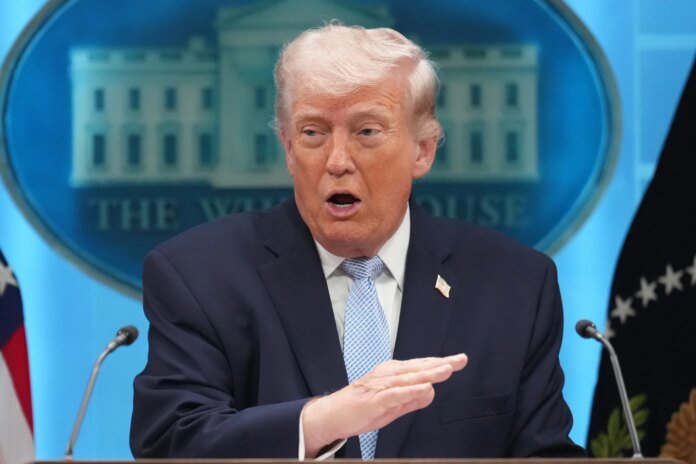
US President Donald Trump on Monday expanded his threat against Iran to include all of the country’s power plants and bridges, as his ultimatum to make a deal ticked closer after Tehran rejected a 45-day ceasefire proposal and said it wants a permanent end to the war.
“The entire country can be taken out in one night, and that night might be tomorrow night,” Trump said. He suggested that his deadline of 8 p.m. ET on Tuesday (3 a.m. Israel time on Wednesday) was final, saying he’d already given Iran enough extensions.
“We have a plan… where every bridge in Iran will be decimated by 12 o’clock tomorrow night, where every power plant will be out of business, burning, exploding and never to be used again, I mean, complete demolition, by 12 o’clock, and it will happen over a period of four hours if we want that to happen,” he said.
“We don’t want that,” he added, noting that the US may end up helping Iran rebuild, in which case he would not want to have to reconstruct expensive infrastructure like that.
He said Iran did not take him seriously before, leading him to order the demolition of a major bridge near Tehran last week within minutes of talks falling apart.
“Do I want to destroy their infrastructure? No. It would take them 100 years to rebuild,” he said.
“If we left today, it would take them 20 years to rebuild their country… and the only way they’re going to be able to rebuild their country is to utilize the genius of the United States of America,” he claimed.
At an earlier White House Easter egg roll event, Trump was asked if his plans to blow up civilian bridges and power plants in Iran would constitute war crimes, and said they would not “because they [Iran] killed 45,000 people in the last month.”
The comments appeared to refer to Iran’s gunning down of thousands of protesters earlier this year amid a large-scale rebellion against the theocratic regime.
“You know what’s a war crime? Allowing a sick country with demented leadership to have a nuclear weapon,” Trump added.
At the later press conference, a reporter again pressed the president on his threat to bomb Iranian civilian infrastructure, to which the president responded by insisting that the Iranian people would be okay with such strikes.
“They would be willing to suffer that in order to have freedom,” he said, adding that Iranians are urging the US to “please keep bombing.”
Asked what his reaction would be if Iranians were to return to the streets, Trump acknowledged that doing so could well be a death sentence, saying: “They should do it. But the consequences are great. They were told, ‘If you protest, you will be shot immediately.’”
He said earlier that Iranians live in a “violent, horrible world,” where “if you protest, you get shot.”
Iran’s army responded defiantly to Trump Monday night, saying the US president’s “arrogant rhetoric” on the war was not hindering the country’s soldiers.
“The rude, arrogant rhetoric and baseless threats of the delusional US president… have no effect on the continuation of the offensive and crushing operations of the warriors of Islam against the American and Zionist enemies,” said a spokesman for the army’s Khatam Al-Anbiya central command cited by state media.
Iran’s deputy sports minister, Alireza Rahimi, called on artists and athletes to form human chains at power plants across the country on Tuesday.
“We will stand hand in hand to say: Attacking public infrastructure is a war crime,” Rahimi said on X.
Reopening Hormuz a ‘very big priority’
Asked whether he would accept Iran charging toll in the Strait of Hormuz after Tehran reopens the channel, Trump suggested the US could be the one charging such tolls.
“Why shouldn’t we? We’re the winner. We won. They are militarily defeated,” he said.
He later appeared to back off the idea.
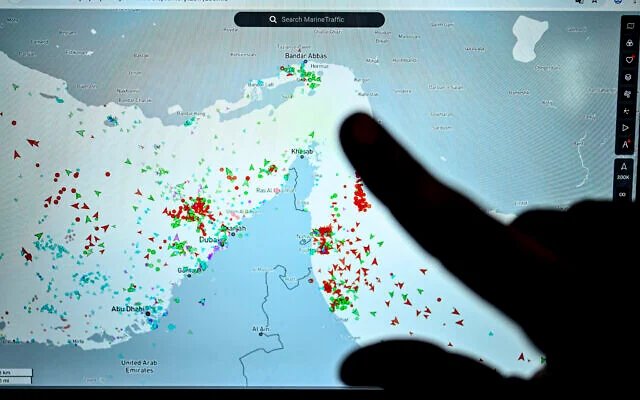
“We have to have a deal that’s acceptable to me, and part of the deal is going to be that we want free traffic of oil and everything else,” he said, adding that reopening the Strait of Hormuz is a “very big priority,” and that it does not take much for Iran to be able to obstruct traffic in the channel.
After the US and Israel attacked on February 28, Iran effectively closed Hormuz, a conduit for about a fifth of the world’s oil and natural gas supply. The waterway’s stranglehold on the global economy has proved a powerful bargaining chip, and Tehran is reluctant to relinquish it too easily.
In the past, Trump has indicated that the reopening of the strait is not a necessity for US interests and that other countries can go in “and just take” the oil.
Asked to explain his seemingly contradictory messaging from the past several days in which he has both said the war is coming to an end and has threatened to bomb Iran back to the Stone Age, Trump said it “depends” on what Iran does.
He again recalled his Tuesday night ultimatum for Iran to accept a deal to end the war and reopen the Strait of Hormuz — a deadline that he has already pushed off twice.
“They asked for an extension of seven days. I said, ‘Give them 10 days,’” Trump said. He would go on to push it off by an additional 24 hours on Sunday.
“I thought it was inappropriate [to attack] the day after Easter. I want to be a nice person. They have until tomorrow. Now we’ll see what happens,” Trump asserted.
“They’re negotiating, we think in good faith,” Trump said of Iran.
“We’re getting the help of some incredible countries that want this to be ended, because it affects them also,” he said.
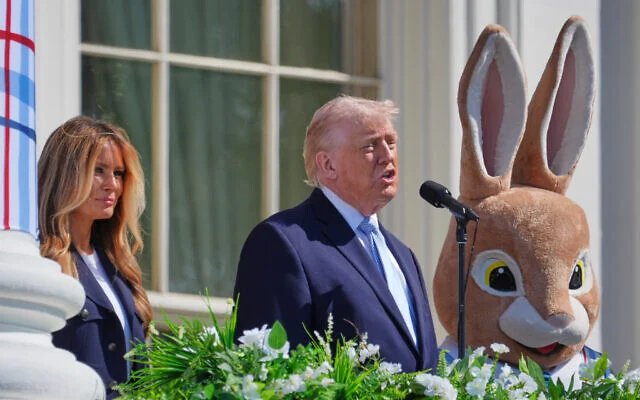
At the earlier Easter event, Trump said that he would like to “take” Iran’s oil but will refrain from doing so because the American public wants the war to end quickly.
“We are obliterating [Iran]… and they just don’t want… to cry ‘uncle,’” Trump said. “But they will [cry ‘uncle’]. And if they don’t, they’ll have no bridges, they’ll have no power plants, they’ll have no anything.”
“Unfortunately, the American people would like to see us come home. If it were up to me, I’d take the oil, keep the oil, and make plenty of money,” Trump said.
Iranian truce proposal ‘significant’ but insufficient
At the Easter event, Trump also confirmed having received a proposal from Iran for a ceasefire, calling it “significant,” while clarifying that it doesn’t go far enough.
The Pakistani-brokered framework for ending the war proposed an immediate ceasefire, followed by talks on a broader peace settlement to be concluded within 15 to 20 days, a source aware of the proposals said.
“They’ve made a proposal… It’s not good enough, but it’s a very significant step,” Trump said.
Iran has been “negotiating in good faith,” he added, claiming that its new leaders are “not as radicalized” and that the war could “end very quickly.”
Trump has recently tried to make the argument that killing a series of leaders within the Islamic Republic had achieved the goal of “regime change” in Iran, even though Tehran’s regime remains intact.
“Iran cannot have a nuclear weapon. They are lunatics, and you can’t put nuclear weapons in the hands of a lunatic,” he said of Iran’s leaders, whom moments prior he had characterized as “much more reasonable.”
He also went on to claim that Israel would have been “wiped off the face of the earth” had he not pulled out of the Iran nuclear deal in 2015, and said the current war was “about one thing: Iran cannot have a nuclear weapon.”
“I told this to Bibi Netanyahu yesterday,” he said at the White House, using the Israeli premier’s nickname.
Trump also repeated his oft-stated bewilderment with the majority of US Jews who vote for Democratic politicians.
“How Israel can vote for a Democrat — if you’re Jewish in New York City or any place else in this country, how you can vote for a Democrat is unbelievable because [former US president Barack Obama] chose Iran,” Trump said, appearing to conflate American Jews with Israel.
Hundreds of soldiers took part in rescue mission
Regarding the decision to launch an operation to rescue two American airmen whose plane was shot down in Iran over the weekend, Trump revealed that some of his military advisers had not been supportive of the idea, due to the risk it would pose to those taking part.
“Not everybody was on board,” Trump said. “There [were] military people — very professional — [who] preferred not doing it.”
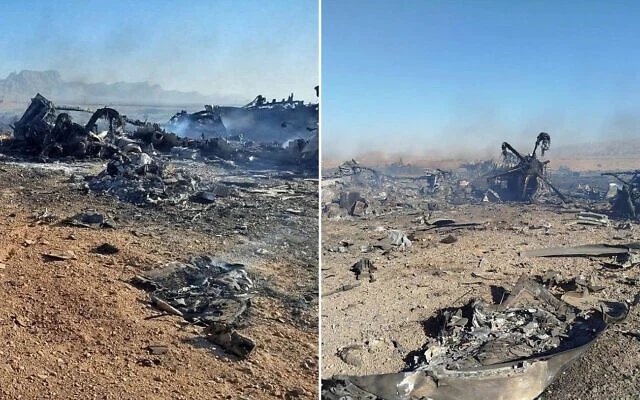
He clarified that Defense Secretary Pete Hegseth and Joint Chiefs of Staff Chairman Gen. Dan Caine were not among those skeptics.
“Somebody said, ‘This was the only time it’s ever been done,’” Trump claimed. “Look at some of the helicopters, how they got hit.”
He then asked Caine how many soldiers took part in the rescue, but the Joint Chiefs chairman responded: “I’d love to keep that a secret.”
“I’ll keep it a secret, but it was hundreds,” Trump said.
“I was told that this is a very dangerous mission. They didn’t say it’s a foolish mission,” he clarified.
Hegseth, who has faced scrutiny for outspokenly blending his evangelical religious faith with military operations, also spoke at the press conference, describing the rescue in explicitly Christian terms, comparing it to the resurrection of Jesus Christ.
The rescue mission came amid rising concern about the nearly six-week-long war’s effect on the global economy, including a sharp rise in fuel prices. The conflict has also hit Trump’s approval ratings and intensified anxiety among Republicans about November’s midterm elections.
Times of Israel staff and agencies contributed to this report.
Source:
www.timesofisrael.com


