
NEW YORK — After the New York City Council passed legislation meant to protect houses of worship on Thursday, mainstream Jewish groups took a victory lap.
New York City Council Speaker Julie Menin, the Jewish descendant of Holocaust survivors who led the effort to pass the bill, held an event with other Jewish leaders the following morning to celebrate at Manhattan’s Park East Synagogue.
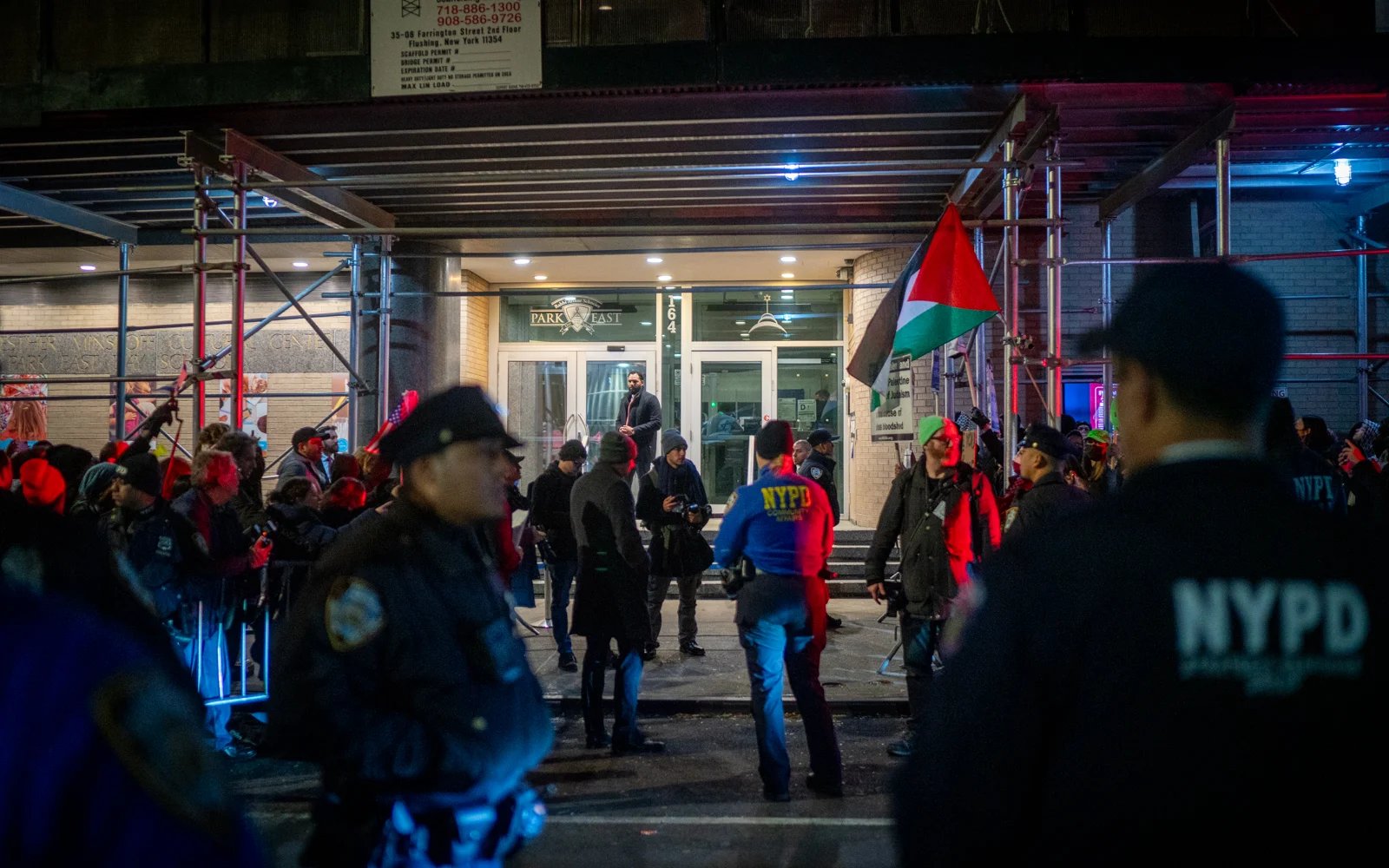
A vitriolic protest at the synagogue, and another, weeks later, at a Queens synagogue, were the impetus for the legislation.
“This is such an exciting moment. There are people who doubted our ability to do this, but we got it past the finish line, and we got it past the finish line with this overwhelming vote of support,” Menin said.
The bill marked a welcome victory for Jewish New Yorkers who are alarmed about the ascendancy of the city’s anti-Zionist mayor, Zohran Mamdani, and his far-left allies.
The legislation passed by a margin of 44 votes in favor and five against in the 51-member City Council, giving it a veto-proof majority before it heads to Mamdani’s desk for approval. The bill calls on the police to formulate and make public plans to prevent potential interference at the entrances to houses of worship.
The overwhelming support signaled the limited power of the far left in the council, and was a show of strength for Menin and her allies.
The council handles local legislation, negotiates the city’s budget with the mayor, monitors city agencies and reviews land use. The body is a separate governmental branch from the mayor’s office, but interacts with the mayor and serves as a check on City Hall.
The City Council speaker is a powerful role in the city government that can serve as a counterweight to the mayor’s office. The bill to protect houses of worship was Menin’s first legislative proposal since she became speaker and the most prominent part of her five-point plan to combat antisemitism in the city, where Jews are targeted in hate crimes far more than any other group.
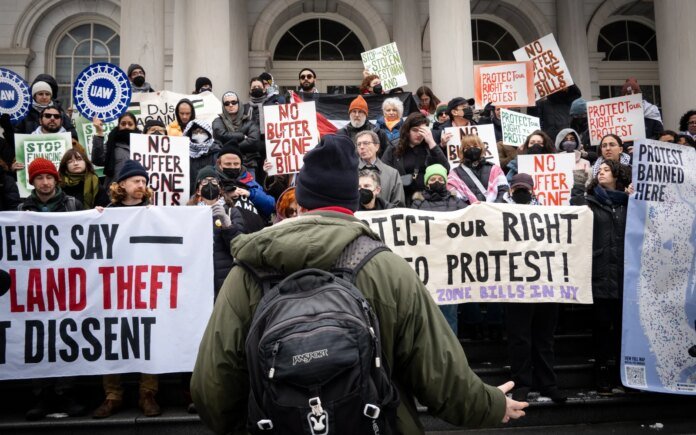
Leftist and anti-Zionist groups had launched a sustained campaign against the legislation, calling it an attack on free speech and oppressive toward Palestinians, holding two rallies on the steps of City Hall this month and last month as the council debated the bill. Organizers of the two protests that led to the bill said they were targeting events linked to West Bank settlements.
Among the legislation’s opponents was the city’s branch of the Democratic Socialists of America (DSA), Mamdani’s home base.
“Julie Menin is trying to crack down on your right to protest and ramp up surveillance on New Yorkers. Don’t let the City Council erode our rights,” the party said on Tuesday.
Menin and other advocates repeatedly said the measure would not infringe on free speech rights, and the legislation stipulates that the NYPD must formulate its plans “while preserving and protecting the rights to free speech, assembly, and protest.”
At the Friday rally, Menin said, “The First Amendment right to peacefully protest is sacrosanct. It is what our country is built on. Nothing in the bills stands in that way.”
“People can peacefully protest and express their rights as existed before, but what this bill does is say you do not have the right to intimidate and harass people as they are entering their house of worship,” she said.
Another group campaigning against the bill was the leftist Jews for Economic and Racial Justice, Mamdani’s most prominent Jewish ally group in his campaign.
Despite the pressure, only five councilmembers opposed the measure, including all four DSA members, indicating a more centrist view still holds in the council despite the further left City Hall.
Mamdani has not confirmed whether he will approve or reject the legislation, not taking a side with either mainstream Jewish groups or his allies, although his office has voiced concerns about its possible infringement on constitutional rights.
If the mayor vetoes council legislation, the City Council can override the veto with a two-thirds majority, and the 44 votes in favor surpass that threshold. If Mamdani takes no action, the bill also becomes law in 30 days.
That takes some of the pressure off Mamdani, as it will not be up to him to decide whether the legislation becomes law or not.
In one notable endorsement, the progressive New York Jewish Agenda advocacy group applauded the measure and urged Mamdani to sign it into law. The former head of the group, Phylisa Wisdom, leads Mamdani’s Office to Combat Antisemitism.
The legislation will not likely have a huge impact on the ground, though.
The bill initially called for a protected area of up to 100 feet (30.5 meters) around houses of worship, but was later watered down after the NYPD expressed concerns about enforcement logistics. The updated text removed mention of a specific distance.
The legislation directs the NYPD to “establish a plan to address and contain the risk of physical obstruction, physical injury, intimidation, and interference at places of religious worship,” and to make those plans public.
Police representatives have said the legislation would not have a huge change on how officers operate, but would increase transparency around their handling of protests.
“The bill would not change what we do day-to-day. It would require us to articulate, and put in words on paper, what our approach is in these situations,” Michael Gerber, the NYPD deputy commissioner for legal matters, said at a hearing last month.
Police will be required to engage directly with houses of worship and protesters about security plans, Menin said.
“This provides transparency and accountability to a process that was very opaque before,” Menin said on Thursday. “It also requires the NYPD to do community engagement, which didn’t exist before.”
The bill does not bar protests or establish buffer zones at any specific distance, and police already set up safety barricades around protests at houses of worship.
The legislation, had it been in place during the Park East Synagogue protest, may have prevented protesters from gathering adjacent to the building’s doors, where they threatened and hurled discriminatory epithets at entrants.
Police representatives had already apologized for their handling of the Park East protest, though, and vowed to prevent similar incidents going forward.
The second protest took place in a residential neighborhood in Queens that has a large Jewish population. The demonstrators chanted for Hamas, forcing nearby families to hear the invective late into the night.
At the protest, police kept the demonstrators a block away from the synagogue entrance, inside barricades, and effectively kept the anti-Zionist protesters apart from counter-demonstrators.
Source:
www.timesofisrael.com


