
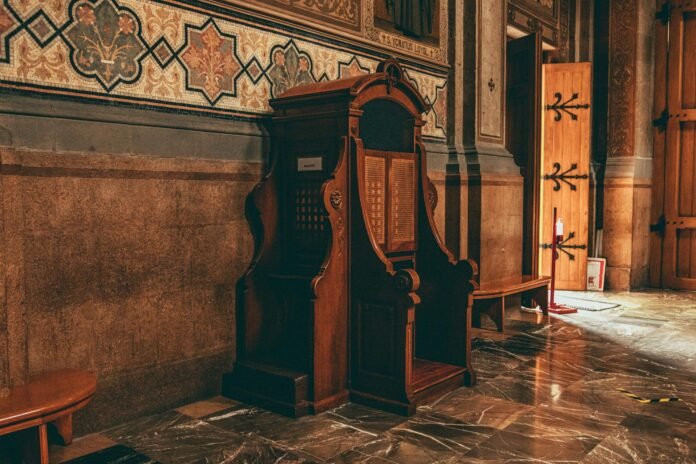
Do you ever go to confession in a Catholic Church?
Most Catholics in the United States who go to Mass at least occasionally say they haven’t been to the confessional in over a year, but a new study suggests a great majority of them would consider going.
A Pew survey in 2025 said only 12 percent of Catholics confess regularly, 12 percent say they go “occasionally” and 77 percent haven’t been in over a year (though the same study says 53 percent of regular Mass-goers confess at least yearly).
A Vinea Research survey this year, however, reported 20 percent saying they go regularly and 12 percent occasionally, while 68 percent haven’t been in over a year.
This latest survey was conducted for the Catholic Pulse Report, and contained what the organization described as positive news.
Distance from confession, the research shows, is shaped more by hesitation, uncertainty, and the absence of habit than by disbelief or rejection.
The survey asked other questions that looked at the “whys” of Catholics’ distance from the sacrament, and found that two thirds of Catholics who have not been to confession in the past year are open to returning, with roughly half expressing a “clear desire” to return.
“This study illuminates not just how often Catholics go, but why they go, why they don’t, and what they experience when they do,” said Hans Plate, Founder of Vinea Research Group.
“As central as Confession is to Catholic life, in-depth national research on this sacrament has been surprisingly limited,” he added.
The report shows that among those who haven’t been to Confession in over a year, 50 percent report embarrassment about speaking their sins and 53 percent find the sacrament uncomfortable.
Both findings point to personal discomfort with the Confession experience.
The report also found that 43 percent of those who go infrequently say they would go more often if they heard that struggling with the same sins is normal, and an equal percentage desire a greater emphasis on mercy over judgment.
“Many Catholics still believe in the sacrament, many have experienced it personally, and many remain open to returning,” Plate said.
“This presents a real opportunity for renewal—not just by inviting Catholics back, but by helping them more fully understand the meaning and power of the sacrament,” he added.
In the 1970s, over 50 percent of Catholics in the United States attended Mass every week. It is now under 20 percent. Confession rates have also fallen dramatically, even among those going to Mass regularly.
Plate said there are many reasons for this.
“There are likely multiple factors, but one contributor appears to be a weaker sense of sin and responsibility before God,” he told Crux Now.
“In our study, we measured this in several ways, and in key areas many Catholics expressed views that suggest a weaker connection between their actions and their relationship with God. Over time, this shift may have reduced the perceived need for confession,” he said.
“That said, it is important to recognize that this is only one part of a broader set of changes – such as cultural, theological, and pastoral – that have influenced participation,” he added.
Plate said there are several reasons people don’t go to confession, but not always the ones people think.
“At the most basic level, many Catholics don’t fully see the need for the sacrament, especially given how many say they can ask God directly for forgiveness without going to a priest,” he told Crux Now.
“At the same time, there is a clear sense of discomfort associated with confession – both in naming their sins out loud and in the Confession experience itself,” Plate added.
“Importantly, this is not primarily about people thinking their sins are too minor. Only slightly more than a third say that, which suggests the deeper barriers are more about understanding, comfort, and habit than about the seriousness of sin,” he claimed.
Plate said “focusing on God’s mercy is essential” for priests to encourage more people to go to confession.
“In our study, the desire for mercy is the strongest draw to confession, and many Catholics remain open to returning when that message is clearly communicated,” he told Crux Now. “It’s also important to help people understand the unique value of the sacrament,” he said, “especially the difference between asking God for forgiveness in private prayer and receiving absolution through confession.”
“Many Catholics do not fully recognize the grace and assurance that come through the sacrament,” he continued. “Beyond that,” he also said, “it helps to speak to the lived experience of those who go: interior peace, freedom from the burden of sin, healing, and spiritual renewal.”
“Making these fruits more visible can be very compelling,” Plate said.
At the same time, Plate also said priests need to avoid an approach to preaching confession with a sermon that overemphasizes fear or judgment “without clearly presenting God’s mercy,” explaining that such an approach can be counterproductive.
“While accountability is an essential part of the spiritual life,” Plate told Crux Now, “the findings suggest that what actually brings people back is a focus on God’s mercy, not pressure.”
Follow Charles Collins on X: @CharlesinRome
Source:
cruxnow.com


