

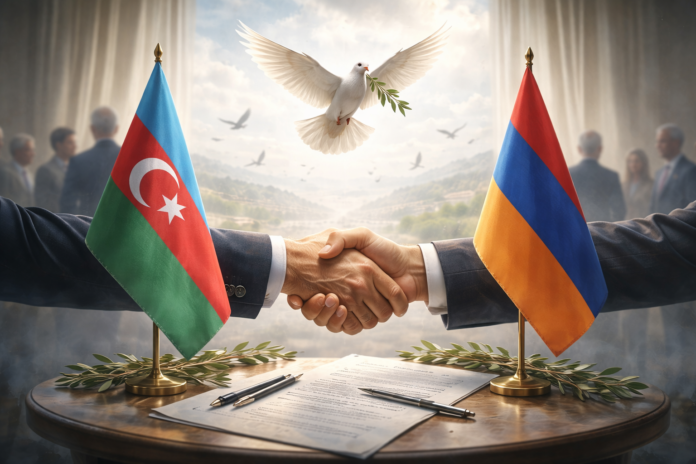
This is not a vague declaration or a routine diplomatic posture. Since late January 2026, Azerbaijani President Ilham Aliyev has repeatedly stated in public that the text of a peace agreement with Armenia is “practically finalized” and that a signature could come in the near term. We are no longer in the exploratory phase of previous years. We are in a precise, time-bound political sequence where every word is weighed and every statement carefully calibrated.
To understand the significance of this moment, one must step back. On September 19, 2023, Azerbaijan launched a swift military operation that, in less than 24 hours, led to the dissolution of the Armenian authorities in Nagorno-Karabakh. From that date onward, Baku has considered the territorial question settled. Throughout 2024, negotiations continued, largely under European and American mediation. As early as December 7, 2023, a symbolic gesture marked a turning point: a prisoner exchange and a rare joint statement between Baku and Yerevan. Over the course of 2024, foreign ministers met repeatedly for technical discussions focused on border delimitation.
The political shift came in August 2025 in Washington, when Aliyev and Armenian Prime Minister Nikol Pashinyan took part in a major diplomatic sequence under U.S. auspices. While this did not yet produce a formal treaty, it marked mutual recognition of the principle of territorial integrity and a commitment to move toward a definitive agreement. From that point onward, the language changed. Baku no longer spoke of open-ended negotiations but of a text under consolidation.
Now, in February 2026, Aliyev’s statements are no longer cautious—they are assertive. He refers to a largely stabilized document, with final adjustments concerning constitutional and technical aspects on the Armenian side. This detail is central: Azerbaijan insists on removing any Armenian constitutional references that could be interpreted as implicit territorial claims. In other words, peace is no longer conditioned by military leverage, but by legal clarification.
The temporal structure gives the current sequence its force. September 2023: full territorial control. December 2023: first political gestures. Throughout 2024: sustained technical negotiations. August 2025: strategic declaration in Washington. January–February 2026: announcement of a near-final text. This chronology shows that Baku has pursued a gradual, methodical strategy aimed at transforming a military victory into a durable diplomatic architecture.
Aliyev now seeks to anchor this agreement in history as the founding act of a new South Caucasus—one centered on regional connectivity, transport corridors, and economic integration. Yet the window is narrow. The present momentum is strong precisely because it is recent, publicly driven at the highest level, and unfolding in an international environment where balances are rapidly shifting. That is what makes February 2026 decisive: if the signature comes in the coming weeks, it will seal a geopolitical transformation nearly two years in the making. If it is delayed, the sequence risks losing its momentum.


