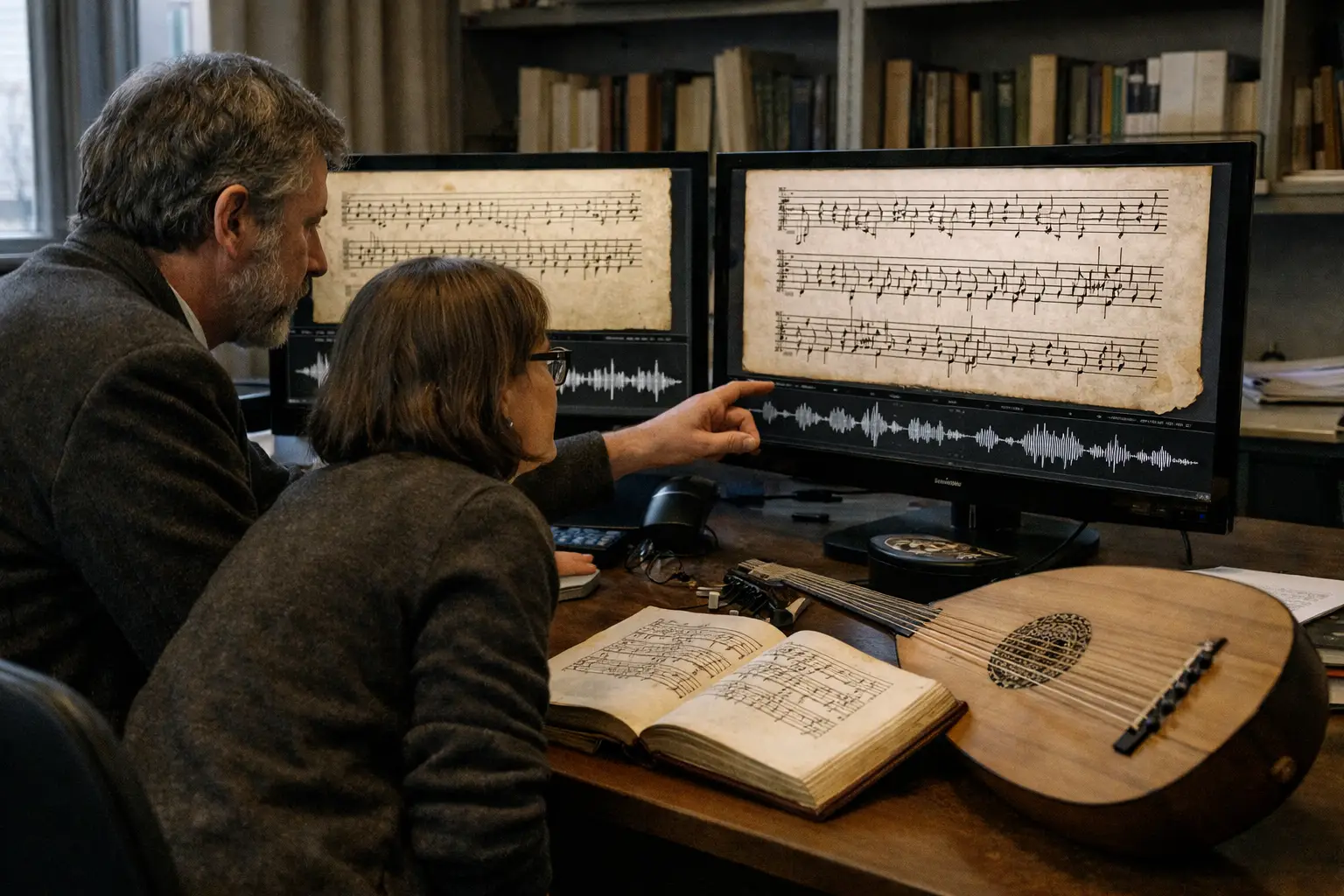
Centuries-old musical signs are being brought back into circulation through a digital project at the University of Bayreuth, where researchers are working to make German lute tablature accessible to today’s readers and listeners. The notation, created for the Renaissance lute, can appear opaque to modern eyes, but it records a repertoire that once circulated widely across Europe: dances, songs and other works that formed part of musical life around 500 years ago.
German lute tablature belongs to the broader history of early music, a field in which many sources survive in systems that differ sharply from the staff notation familiar to most contemporary musicians. Rather than functioning simply as a visual curiosity, tablature was a practical technology for performers. It offered a way to indicate how music should be played on the instrument for which it was designed. Recovering that logic is essential if the surviving sources are to be understood not only as historical documents, but also as music that can be performed again.
The Bayreuth initiative places these materials within a digital scholarly edition platform, a format increasingly important in the digital humanities. Such platforms can support careful editorial work while widening access beyond specialist archives. In this case, the aim is both textual and musical: the sources are being made readable and audible, allowing the notation to be studied and experienced in ways that connect manuscript culture, performance practice and modern research tools.
The work also highlights the value of interdisciplinary research in cultural heritage. German lute tablature sits at the intersection of musicology, historical studies and digital editing, requiring expertise in old notation, instruments and the technical presentation of complex sources. By treating the material as something to be decoded, edited and heard, the project helps bridge the distance between Renaissance musical practice and present-day scholarship.
For performers, students and researchers, the significance lies in access. A repertoire preserved in a specialized notation can remain largely silent when only a small number of experts are able to interpret it. Making these sources available in a digital scholarly environment gives Renaissance music a stronger route back into study and performance, while preserving the historical specificity of the notation that carried it across the centuries.