

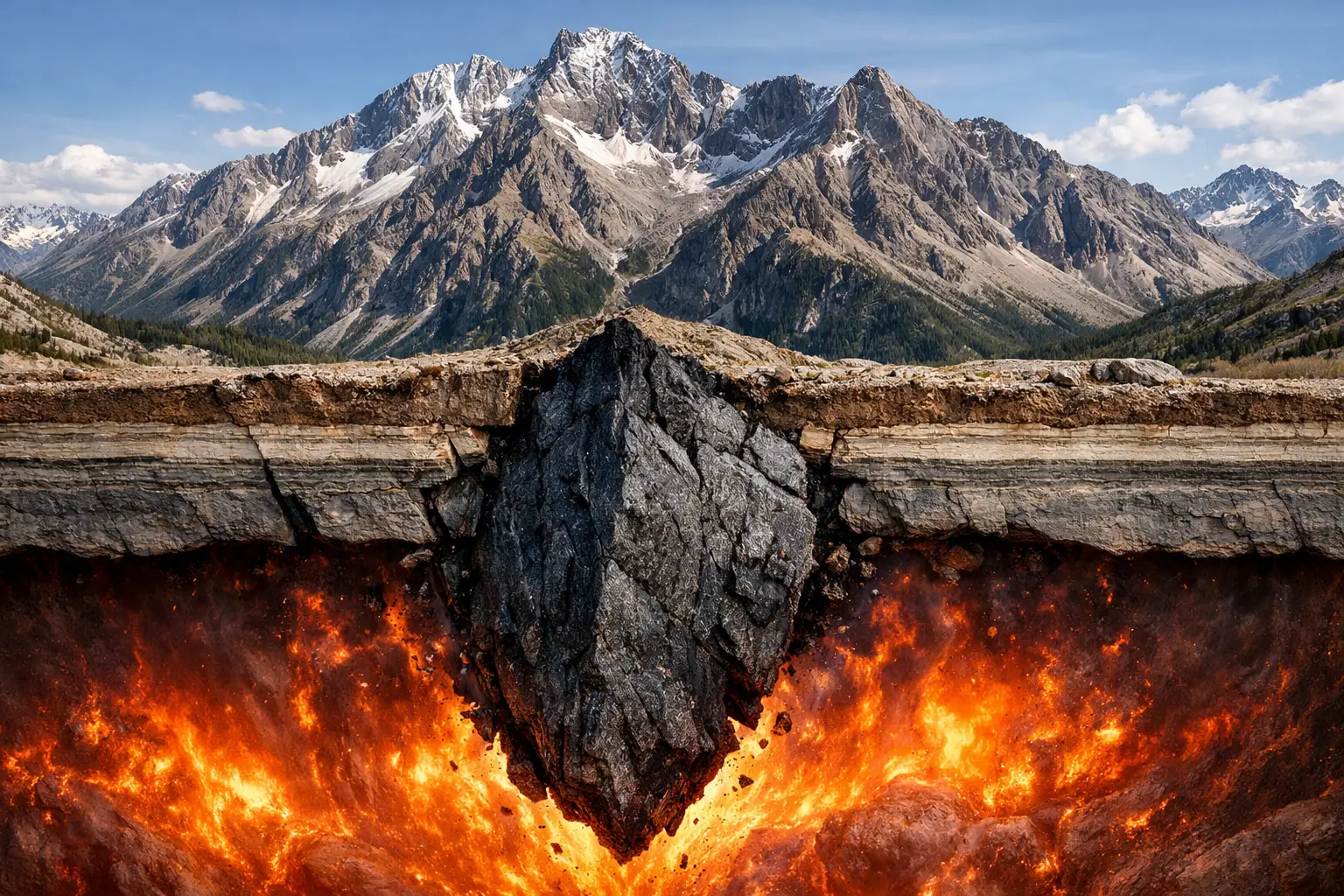
Mountain belts are often described as the product of rock being forced upward, folded, thickened and raised into visible ranges. Yet some of the most important motion can take place in the opposite direction, far below the landscape. Beneath certain mountain systems and volcanic arcs, dense material at the base of the crust may become unstable, detach from the overlying continent and descend deep into the mantle. This process, known as lithospheric dripping, changes the way geologists interpret the hidden architecture of the Earth.
The mechanism begins where the lower crust and the rigid outer shell of the planet meet. If rock at that depth becomes heavy enough compared with the material below it, gravity can begin to pull it downward. Rather than rising with the mountains above, the dense root can break away and sink hundreds of kilometers into the mantle. As it descends, it can tug on nearby parts of the lithosphere, the stiff outer layer made up of the crust and the uppermost mantle.
Seismic imaging has made this deep process visible indirectly. By analyzing how earthquake waves move through the planet, researchers can identify zones where rock has a different temperature, composition or density from its surroundings. Such images suggest that lithospheric dripping has occurred beneath the central Andes and under California’s Sierra Nevada. These regions are important because they show that continental interiors and mountain belts are not only built from the surface upward; they are also reshaped from below.
The idea matters for understanding why some mountain belts evolve in complex ways after they form. If dense lower-crustal material is removed, the balance of forces inside the continent can change. The sinking mass can also influence the deeper mantle around it, linking processes at the surface with movements far beneath the crust. For geologists, lithospheric dripping offers a way to connect mountain building, volcanic arcs and the long-term recycling of continental material without reducing these landscapes to simple uplift alone.
Because the process happens far beyond direct observation, it depends on interpreting seismic structures rather than watching rock detach in real time. Even so, the evidence from the central Andes and the Sierra Nevada points to a dynamic view of continents: their foundations can founder, separate and descend, while the land above preserves only part of the story. The result is a quieter but powerful form of geological change, hidden hundreds of kilometers below the mountains it helps to shape.


