

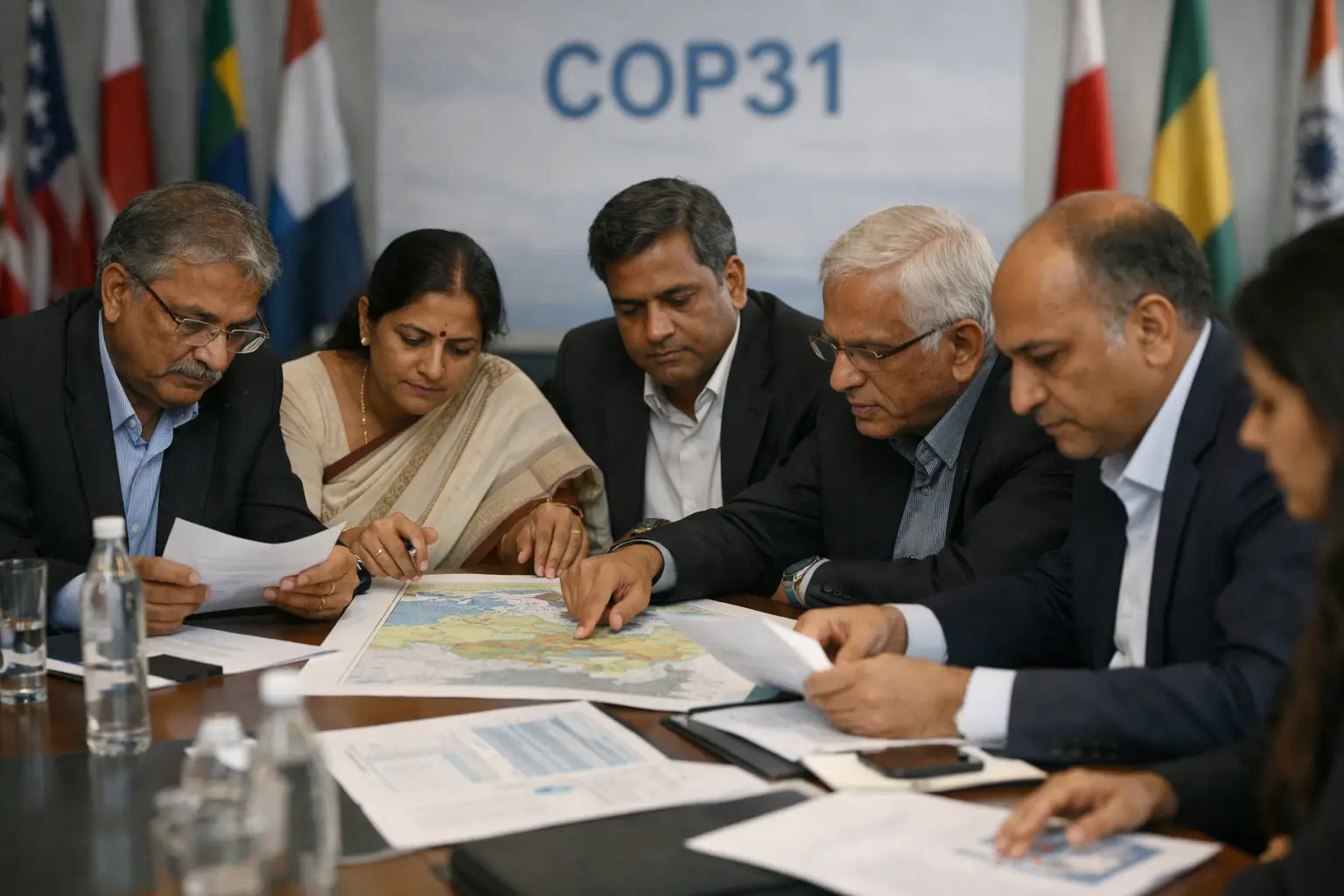
India’s position at COP31 brings a difficult question to the centre of international climate diplomacy: how fast can a country move away from coal when large numbers of workers, families and local economies still depend on it? The argument advanced by India is not a rejection of climate action. It is a demand that the energy transition be matched by a social and economic transition capable of protecting communities exposed to disruption.
The phrase “just transition” has become common in negotiations under the UNFCCC, but its meaning varies sharply between countries. For economies where coal remains tied to employment, public revenue, electricity supply and regional development, the issue is not only the replacement of one energy source with another. It is also the creation of alternative livelihoods, industrial capacity, skills and public services before existing systems are dismantled. That is the basis of India’s insistence on country-led pathways rather than uniform timelines designed without regard to domestic conditions.
Coal-dependent regions face a particular risk when climate targets advance faster than economic adjustment. Mine closures, reduced demand and shifts in investment can leave workers without comparable jobs and local authorities without the resources needed to manage change. In this context, India argues that transition planning must remain rooted in national circumstances. The point has wider relevance for many developing economies, where climate commitments operate alongside poverty reduction, industrialisation and energy-access priorities.
A country-led approach does not remove the need for emissions reductions. It changes the sequencing and governance of the process. It places responsibility on governments to develop credible plans, while also putting pressure on international partners to support finance, technology, skills and institutional capacity. Without those elements, the shift away from coal can become politically fragile and socially uneven, weakening public support for long-term decarbonisation.
The debate at COP31 therefore reflects a broader tension in global climate change policy. Ambitious targets remain essential, but their durability depends on whether they can be implemented without deepening inequality. India’s emphasis on nationally defined just transition pathways highlights a practical constraint in climate diplomacy: the transition will not be judged only by how quickly energy systems change, but also by whether the people most affected are given a realistic route into the new economy.


