

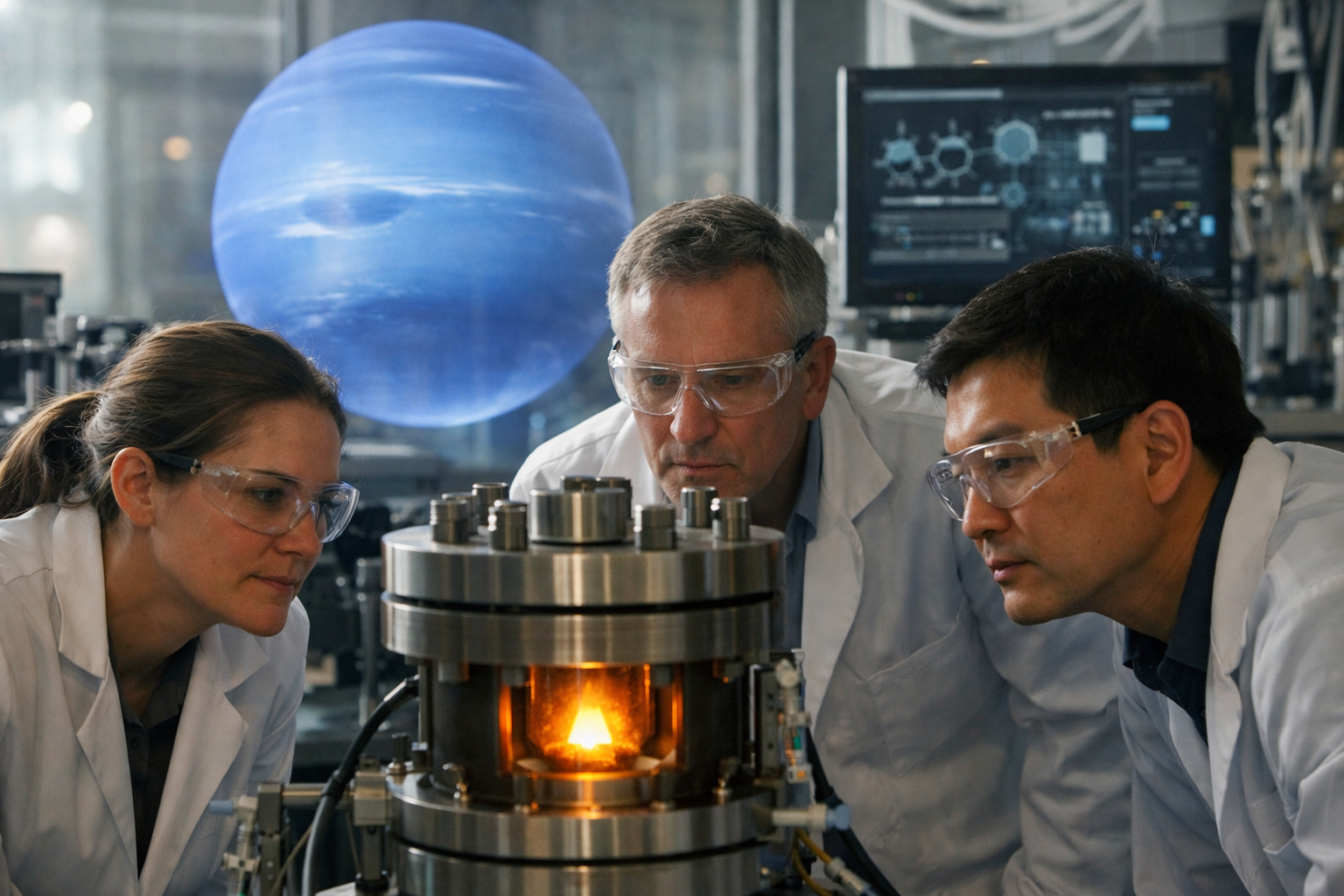
Laboratory researchers have for the first time melted a diamond under controlled conditions to reproduce a carbon transformation long thought to occur inside ice giant planets. By recreating the extreme combination of heat and pressure believed to exist deep beneath the cloud tops, the team produced the same type of phase change that is widely described as ‘diamond rain’. The milestone provides direct experimental evidence connecting theoretical models to physical processes.
The result bears on our understanding of worlds such as Neptune and Uranus, whose interiors reach pressures and temperatures far beyond those on Earth. For decades scientists have proposed that carbon-bearing compounds in those planets can break down and reassemble into denser carbon phases that sink through the envelope. Successfully reproducing that transformation in the laboratory strengthens the plausibility of that scenario under planetary conditions.
Beyond confirming a long-standing hypothesis, the experiment supplies empirical constraints that can refine models of ice giant structure and evolution. Improved knowledge of how carbon converts under extreme conditions affects estimates of internal composition and heat transport, and helps clarify the distribution of heavy elements within these planets. Such data provide a firmer physical basis for interpreting remote observations and guiding the design of future missions aimed at probing deep planetary interiors.
While the work does not rewrite the basic picture that diamonds can form inside ice giants, it marks a significant step in translating theoretical ideas into measurable phenomena. The achievement highlights the value of high-pressure laboratory experiments for testing planetary science hypotheses and narrowing uncertainties about processes occurring far beneath cloud layers. Continued experimental and observational efforts will be needed to build a more complete picture of these distant, enigmatic worlds.


